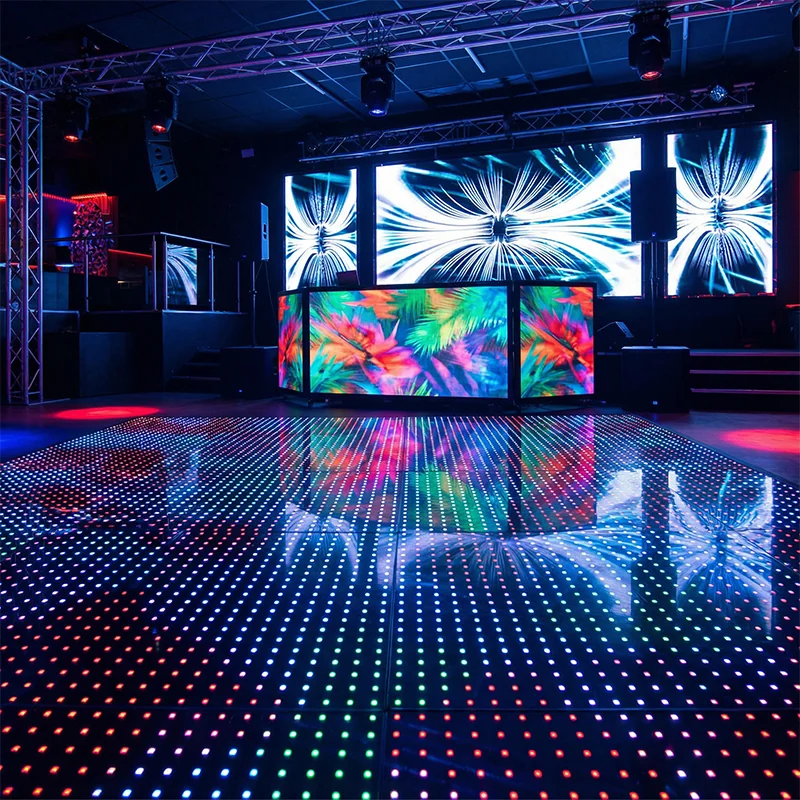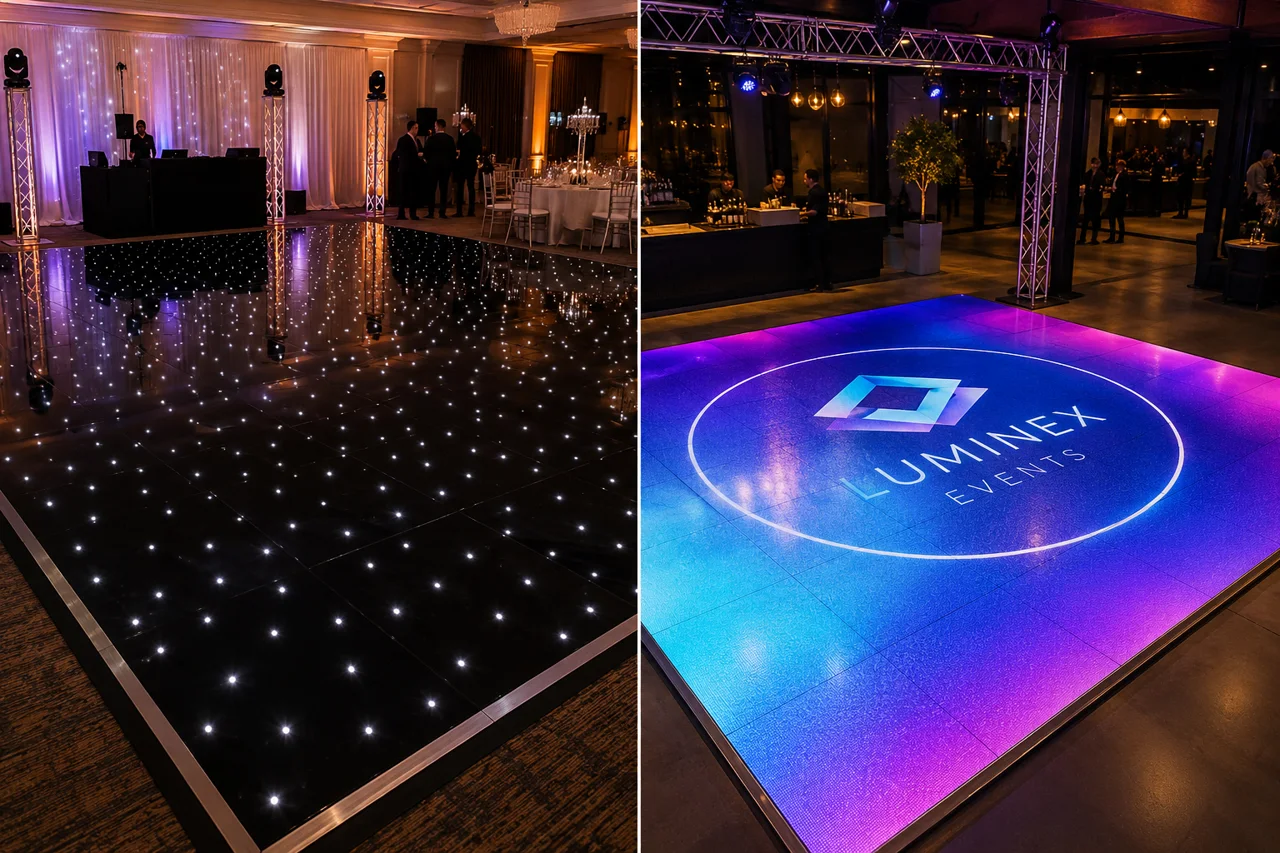
This guide covers RGB, mirror, starlight and programmable pixel lighting dance floors. Video display floors and interactive sensor floors are outside the current product range.
Which Should You Add to Your Fleet?
The star vs pixel LED dance floor decision comes down to one question: do you want a floor that runs 96 ready-made light effects, or a floor that displays your client's logo, text, and animation on the surface? Both are DanceFloorLED dance floors on the same tempered-glass platform, but they solve different problems. This guide lays out the difference, the specs side by side, and a simple way to decide which one to add first.
Fact: DanceFloorLED has 13 years of LED dance floor manufacturing experience and has delivered over 100,000 sets with a 98%+ on-time delivery rate.
The Core Difference in 30 Seconds
The star LED dance floor is a light-effect floor. It layers a starry pattern over a 3D mirror base and ships with 96 built-in effects. You pick a preset, hand the client a remote, and the floor runs itself.
In short: the star is for volume events, and the pixel is for branded events.
What Each Floor Actually Does
The star floor's job is atmosphere. Its 96 presets cycle through twinkles, waves, chases, and color sweeps, and the 3D mirror base adds depth underneath the points. It looks right at a wedding, a birthday party, and a DJ set without anyone touching the controls beyond picking a preset.
Side-by-Side Spec Comparison
Both floors share the same base platform, so the spec table is mostly about the content capability, not the build quality.
Spec | Star | Pixel |
|---|---|---|
Visual effect | 3D mirror + starry pattern | Custom text, logo, animation |
Built-in effects | 96 presets | Custom content |
Custom content | No | Yes (text, logo, monogram, animation) |
Glass | 10mm tempered | 10mm tempered |
Load capacity | 600-700kg per panel | 10 mm tempered glass; vehicle load approval is not established |
Waterproofing | IP67 | IP67 |
LED type | SMD 5050 RGB | LED 5050, 120lm/W |
Colors | 16.7 million | 16.7 million |
Refresh rate | 2000Hz | 2000Hz |
Control | DMX, remote, sound, controller | Tablet, PC, DMX512, remote, WiFi |
Certifications | CE /RoHS; separate CNAS laboratory reference | CE /RoHS; separate CNAS laboratory reference |
Fact: The star LED dance floor combines a 3D infinite mirror effect with a starry pattern and 96 built-in dynamic effects.
Where Each Floor Earns the Most
The two floors suit different bookings, and that is usually how operators decide.
The star floor wins weddings, birthday parties, school dances, and DJ sets. Those jobs want atmosphere and motion, and the 96 presets deliver both without any content production. The star is the floor you put on the truck for most weekend work.
The pixel floor wins corporate launches, trade shows, brand activations, and upscale weddings where the client wants a monogram or message. Those jobs are fewer but higher-rate, and they only exist because the floor can show custom content. For a look at how the pixel fits the wider lineup, see the types of LED dance floor.
Customization: Presets vs Pixel Control
This is the real decision point, so it is worth being precise about what each floor can and cannot do.
The star floor gives you 96 preset effects. You can change colors, patterns, and speed, but you cannot put a specific image, word, or logo on the surface. If a client asks for their name in lights, the star floor cannot do it.
Neither floor is strictly better; they serve different requests. If you want to understand how the star compares to the premium 3D abyss, see the 3D abyss vs star comparison.
Durability and Outdoor Use
On durability, there is almost nothing to decide, because the two floors share the same build.
The product FAQ describes a rechargeable option with a 6000 mAh battery, a 2–3 hour charge time and approximately 10 hours of use. These figures apply to that option. Select the battery, controller and charging configuration for the order; do not assume the separate 26-hour or 36-hour range options are upgrades for this model. Battery power does not permit use in rain.
That means your star-vs-pixel choice is a content and positioning decision, not a quality decision.
Cost and ROI
Because the two floors share a platform, the price gap between them is modest, and the ROI difference comes from how each one books.
The star floor recovers its cost on volume. Its 96 presets and plug-and-play setup mean it rents for a wide range of events, so it tends to book more frequently. The pixel floor recovers its cost on rate. Branded and corporate jobs are fewer, but clients pay more because they are getting custom content they cannot get from a preset floor.
The practical takeaway is the same as with the star and the 3D abyss: run both. The star covers steady weekend volume, and the pixel captures the branded bookings that a preset-only competitor cannot quote.
Which Should You Add First?
If you can only add one floor right now, the answer depends on the bookings you already get.
Start with the star if your calendar is weddings, parties, and DJ events. Its 96 presets mean you can add it to your trailer and rent it this weekend with zero content work.
Start with the pixel if your pipeline already includes corporate clients, trade shows, or sponsors who ask for a logo on the floor. Those requests are exactly what the pixel is built for, and a preset floor cannot serve them.
If you are building a fleet, the strongest setup is one of each: the star for volume and the pixel for custom-content upsells.
FAQ
What is the difference between a star and pixel LED dance floor?
Are star and pixel dance floors the same durability?
Both pages list 10 mm tempered glass and an IP67 panel rating, but neither establishes identical hardware, battery or controller compatibility. The Star FAQ gives 600–700 kg per panel; vehicle wheel-load or driving approval must not be inferred for either floor. Compare both the effect and the full selected configuration.
Which should I buy first, star or pixel?
If your bookings are mostly weddings, parties, and DJ events, buy the star first; its 96 presets cover those jobs without any content work. If your pipeline is corporate launches, trade shows, and branded events, buy the pixel first, because those clients specifically ask for a logo or message on the floor. A fleet that has both covers the full market.
Do star and pixel floors work outdoors?
The product FAQ describes a rechargeable option with a 6000 mAh battery, a 2–3 hour charge time and approximately 10 hours of use. These figures apply to that option. Select the battery, controller and charging configuration for the order; do not assume the separate 26-hour or 36-hour range options are upgrades for this model. Battery power does not permit use in rain.
Conclusion
The star and pixel LED dance floors are not rivals; they are two answers to two different requests. The star delivers 96 ready-made effects for volume events, and the pixel delivers custom text, logos, and animations for branded events.
Add the star first if you book volume, the pixel first if you book corporate, and both if you want a fleet that can quote every job in the room. See the star LED dance floor product page and the pixel LED dance floor product page to compare full specifications, or request a quote for your fleet.
Sources
1. DanceFloorLED. "Star LED Dance Floor." Product page, dancefloorled.com. https://dancefloorled.com/star-led-dance-floor (Primary source for the star product specifications, the 96-effect library, and the 600-700kg load rating.)
2. DanceFloorLED. "Pixel LED Dance Floor." Product page, dancefloorled.com. https://dancefloorled.com/pixel-dance-floor (Primary source for the pixel product specifications, custom content capability, and control methods.)
Note: All technical specifications in this article are per manufacturer specifications, as stated on DanceFloorLED's official product pages. This is a product-specific technical guide, so no third-party market data or pricing is required or cited.
LED Dance floor IP67 Waterproof LED Floor