Star LED Dance Floor ROI: Rental Rates, Payback and Utilization
The star LED dance floor ROI question has two answers, and most buyers only ask for one. The first answer is the payback figure: how many rentals it takes to recover the purchase price. The second answer is the one that actually decides whether the floor was a good buy, which is how much revenue each dollar of equipment spend produces in a year. Those two numbers move on different levers, and the star model wins on the second one.
Fact: DanceFloorLED has 13 years of LED dance floor manufacturing experience and has delivered over 100,000 sets with a 98%+ on-time delivery rate.
What payback actually measures
Two metrics from the equipment rental industry do most of the work here, and neither of them is specific to dance floors.
Cost figures in this section are planning examples from the article’s publication date.
Dollar utilization divides annual rental revenue by the acquisition cost of the asset [1]. It answers a single question: for every dollar you spent on this floor, how many dollars of rental revenue did it generate in a year? A floor that costs $ 6,000 and produces $ 32,000 of bookings in a year returns about 5.3 dollars per dollar of equipment spend.
Utilization rate is the companion metric. It measures how often an asset is out on rent compared to how often it is available to rent [2]. A floor sitting in the warehouse at 40% utilization has a payback problem that no rate increase can fix, because the constraint is dates rather than price.
The third principle comes from how rental rates are set in the first place. The Rental Rate Blue Book approach to cost recovery treats rates as the amount an owner should charge to recover ownership and operating costs, which is a floor on your pricing rather than a target [3]. Profit sits above the recovery line, and the recovery line is what tells you whether a rate is viable before you commit to it.
Put together, the three metrics produce a simple operating rule for a dance floor. Rate per event sets the ceiling on a single booking. Utilization sets how many times you get to charge it. Payback is the result of both, and the star floor's advantage sits almost entirely in the second one.
What a star LED dance floor costs
Purchase cost is the input to every payback calculation, and the band is wider than most first-time buyers expect. Industry listings put budget LED dance floors around $ 3,000, higher-quality floors around $ 6,000 to $ 8,000, and premium configurations above that [6].
Four things move a quotation within that band. Panel size and panel count set how much hardware you are buying, since a 20x20 ft floor is a materially larger order than a 12x12 ft floor. Glass and LED grade set durability and how the floor holds up under rental traffic. The control system sets what the floor can be driven with and who on your crew can run it. Packaging sets whether the fleet travels in a wheeled flight case or a carton, which matters more to a rental business than to a fixed installation.
The Star page lists 10 mm tempered glass, a600–700 kg per-panel rating and an IP67 panel rating. Its 10+year wording refers to the LED source, not a guaranteed whole-floor service period or vehicle-driving capability. Base purchase and payback decisions on the selected configuration and actual operating costs.
The Star product page lists 96 built-in effects,10 mm tempered glass, a600–700 kg per-panel rating and an IP67 panel rating. The 10+year statement is LED-source wording, not a whole-product life or warranty.
What the floor earns: rental rates by size
Rental rates vary by market, floor size and event tier. The table below reflects published 2025 and 2026 listings, presented as market estimates rather than fixed prices.
Floor size | Typical rate per event | Notes |
|---|---|---|
8x8 ft | $ 655 | Entry size for small private parties |
12x12 ft | $ 1,200 | Workhorse size for weddings and parties |
16x16 ft | $ 1,600 and up | Premium 16x16 ft floors reach $ 2,500-$ 5,000 [6] |
20x20 ft | $ 2,000 | The size rental customers most often request |
Premium 16x16 ft and larger | up to $ 8,000-$ 10,000 | High-end galas and branded events [6] |
Per square foot, with setup | about $ 25 | Includes setup and a technician on site [7] |
Two further data points frame the table. Small floors for private parties run $ 300 to $ 1,500 depending on market and size [4], and day-rate packages in the event rental sector run roughly $ 450 to $ 700 [8].
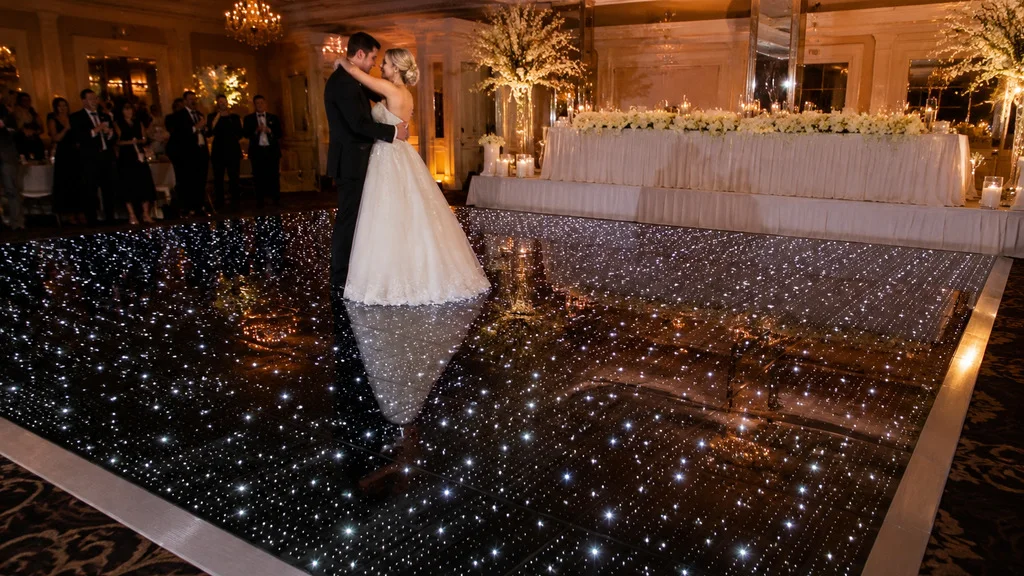
Where does the star floor sit? It books in the mainstream band, so most of its jobs land between $ 1,200 and $ 2,000. That is a deliberate position rather than a limitation. The star effect is a strong visual that photographs well, so the floor can be quoted at the top of the mainstream band without resistance, and it remains able to reach the premium band on gala and premium wedding work. What it does not do is depend on a premium rate to return its cost, which is the point of the next section.
The utilization advantage: zero content preparation
Here is the part of the calculation that rarely makes it into a sales conversation. The star floor needs no content preparation between jobs.
That sentence sounds like a convenience. It is a capacity constraint in disguise. A floor that requires artwork to be built, checked and loaded before a branded event is a floor that depends on a designer being available, and the work repeats for each new client because each client's branding is different. A floor that ships with 96 built-in effects needs cleaning, a functional check and a case, and it can go straight back out.
What that does to a booking calendar
Consider two floors with identical rates and identical purchase prices, one requiring content work and one that does not. Between two back-to-back weekend bookings, the content floor carries an extra task that has to be scheduled, quality checked and approved. The effect floor carries a wipe-down. Over a season, the second floor can accept the last-minute booking, the Friday-to-Sunday double, and the corporate job that lands on a Wednesday.
This is not an argument against content floors. It is an argument about which floor to buy when the pipeline is volume work. The star LED dance floor guide covers the effect library and the platform in detail, and the pixel LED dance floor guide covers what changes when a floor does carry content. Both have a place in a fleet, but they have different operating profiles, and the star profile is the one that maximizes dates.
Effects instead of content
The 96 built-in effects do something the payback spreadsheet misses. They let the same floor look different across bookings without new work. A wedding wants a soft starry field, a school event wants colour sweeps, a corporate party wants something more geometric, and all three come from the same preset library. That is how a single asset serves a diverse booking mix without the client noticing they booked the same floor the venue had last month.
The Star page lists CE and RoHS with a CNAS laboratory reference. A separate rechargeable option is described in its FAQ at 6000 mAh and approximately 10 hours; that does not mean every Star panel includes a battery. Select the power and controller configuration with the order.
The operational costs that scale down with it
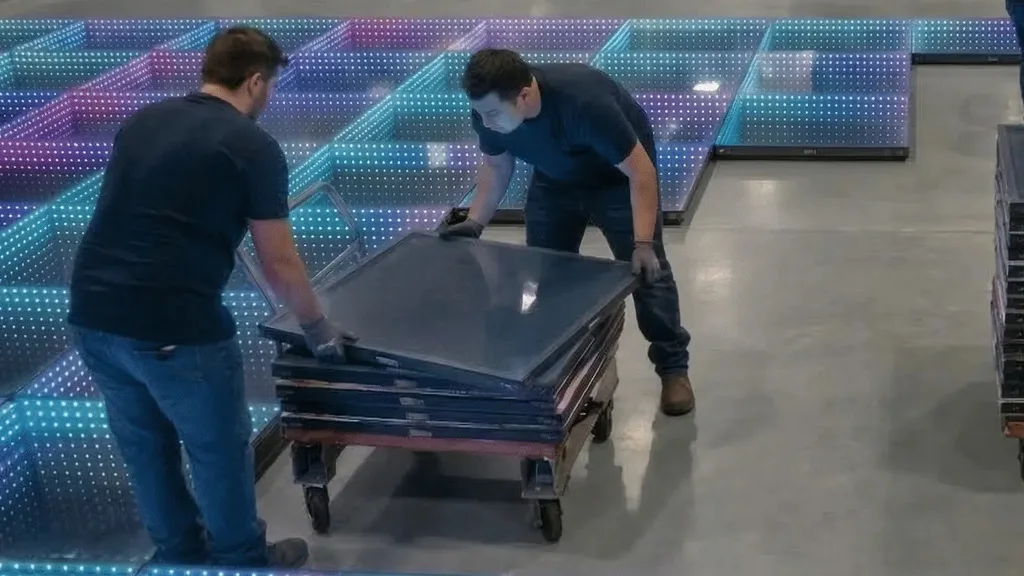
Estimate labour, cleaning and operator training for the selected layout. Magnetic joining may simplify assembly, but one unspecified 8-minute figure and a nominal 20 × 20 ft two-person 30-minute example do not establish a universal labour saving or crew schedule.
Net per event: the costs that sit between rate and profit
The rate on the quotation is not what the floor earns. Four cost lines sit between the two, and ignoring them is how operators conclude a floor is paying back when it is not.
Cost line | What drives it | How to control it |
|---|---|---|
Labor | Crew size and time on site | Magnetic setup, no tools, two-person floor builds |
Transport | Vehicle, distance, case count | Save on case count; a 20x20 ft floor moves in fewer cases than a wired system |
Consumables and cleaning | Surface area and finish | Tempered glass cleans without special products |
Storage, insurance and maintenance | Fleet size and storage footprint | Panel size decides both storage and insurance value |
After labor and transport, industry estimates put net income at roughly $ 1,000 to $ 1,300 per event on a typical booking [6]. A star floor sits at the favorable end of that range on a per-event basis, because the content step that consumes crew hours on other floors simply is not there.
Use the electrical schedule for the selected panel, controller and power-supply configuration to plan demand. The 3D Abyss FAQ lists a 20 W rated-power figure without stating whether it is per panel or per system, so it cannot be multiplied by the panel count. Confirm the configured maximum and average demand before sizing distribution.
The payback math
Now combine the inputs. Purchase cost from the quotes, net per event from the four cost lines above, and the number of events you can realistically book.
Item | Value |
|---|---|
Floor size assumed | 16x16 ft |
Purchase cost | around $ 6,000 |
Rental rate per event | $ 1,600 |
Net after labor and transport | about $ 1,300 |
Events to recover the purchase price | about 5 |
Five events on a $ 6,000 floor is the arithmetic answer. The practical answer is longer, because storage, insurance, marketing and the slow season all take a cut, and because a floor does not book every available weekend.
That is why the honest version of the payback figure is a range rather than a number. Most operators land between five and ten events depending on market, rate and how hard they push the calendar. The floor that books 30 events a year clears that bar in its first quarter. The floor that books eight events a year takes most of a year to get there.
For the premium end of the same calculation, where a 3D abyss floor earns a higher rate per event and recovers its cost through margin rather than volume, the 3D abyss LED dance floor ROI breakdown walks through that model. The two articles reach compatible conclusions from different directions, which is the point: the abyss buys a higher rate, the star buys a fuller calendar.
Three scenarios
Scenario | Bookings per year | Net per event | Annual net | Time to recover a $ 6,000 floor |
|---|---|---|---|---|
Conservative | 12 | $ 1,000 | $ 12,000 | about 6 months |
Active | 30 | $ 1,300 | $ 39,000 | about 2 months |
Premium-heavy | 20 | $ 2,000 | $ 40,000 | about 6 weeks |
The premium-heavy row is not a contradiction of the utilization argument. A floor that books fewer events at higher rates can return cash faster, and that is precisely why a fleet holding both a star floor and an abyss or pixel floor stands on firmer ground than a fleet holding one model. The star floor fills the calendar. The premium floor raises the average.
What the table really shows is where the money moves. Going from 12 bookings to 30 bookings does not require a better floor. It requires a floor that can be turned around between jobs without a specialist, which is the star model's structural advantage, plus the sales work to fill the dates.
Beyond the base rate: where the extra revenue comes from
A floor that only earns its base rate leaves money on the table. Six routes raise the average without buying anything else.
The first is size. Moving a booking from 12x12 ft to 16x16 ft moves it from the $ 1,200 tier to the $ 1,600 tier on the same crew and the same vehicle, which is why the size and style guide is worth reading before you order rather than after.
The second is the premium band. The star effect photographs well from above, which is how most event footage is shot, so the floor can be quoted at $ 2,500 and up on gala and premium wedding work without the scarcity argument that a depth-effect floor needs.
The third is weekday work. Corporate events, product launches and school functions book Monday to Thursday, when a wedding floor sits idle. Those jobs need no new equipment, only a calendar that is not already full.
A car-show application does not establish vehicle wheel-load or driving approval. Confirm the load distribution, base and complete installation for the intended use rather than deriving vehicle suitability from a per-panel number.
The fifth is theme work without new content. A 96-effect library lets one floor serve a different look for each client, so you can charge for a styled floor without owning three floors.
The sixth is the fleet effect. A crew that knows one platform installs it faster and breaks it less often, and the custom LED dance floor OEM/ODM programme covers what changes when you want the fleet branded or built to your own specification.
What breaks the model
Five things turn a good floor into a mediocre asset, and none of them are the floor's fault.
Under-booking is the first and largest. A floor at the back of a warehouse at low utilization fails regardless of its rate, which is why declining a fill-in booking to protect a rate is usually the wrong trade.
Buying the wrong size is the second. A 12x12 ft floor that clients keep asking to upgrade costs you the difference on every booking plus the cost of a second purchase.
Shipping without flight cases is the third. A carton floor is cheaper upfront and more expensive over a season, because rental traffic damages what packing does not protect, and a damaged floor earns nothing.
Ignoring the slow season is the fourth. A year with 30 bookings concentrated into nine months has a cash-flow shape that needs planning, not optimism.
Skipping the maintenance routine is the fifth. IP67 covers spills and dust, but connections and power protection are the parts that fail when a floor is cleaned carelessly, and the fix is a routine rather than a repair.
Star, abyss or pixel on ROI grounds
Model | How it returns its cost | Best for |
|---|---|---|
Star | Booking density. No content step, fast turnaround, mainstream rate band | Weddings, parties, DJ sets, school events, high-volume calendar |
3D Abyss | Rate per event. Premium depth effect, fewer but higher-value jobs, plus permanent installations | Galas, high-end weddings, nightclubs |
Pixel | Rate per event plus brand budgets. Content-driven work funded by marketing spend | Corporate launches, trade shows, branded events |
The decision rule is short. If your problem is filling dates, the star floor is the answer, because it is the floor that can go out twice in a weekend without a designer in the loop. If your problem is that your rates are too low, the abyss or pixel floor is the answer, because those floors change the budget the client is paying from.
If you are deciding between the star and pixel models on booking mix rather than on ROI mechanics, the star vs pixel comparison works through that choice directly, and the 3D abyss guide covers the depth effect from the specification side. The broader cost and specification picture across all four models is in the 2026 LED dance floor buying guide.
Fact: DanceFloorLED's star LED dance floor pairs a 3D infinite mirror base with a starry pattern and 96 built-in effects, and the full specification is published on the star LED dance floor product page.
FAQ
How much does it cost to rent a star LED dance floor?
Market listings put rental rates by size at roughly $ 655 for an 8x8 ft floor, $ 1,200 for 12x12 ft and $ 2,000 for 20x20 ft, with premium 16x16 ft and larger floors reaching $ 2,500 to $ 5,000 and occasionally higher for high-end work [5][6]. Small private party floors start around $ 300 [4]. The star floor sits in the mainstream band, which means it books most often at $ 1,200 to $ 2,000 per event while remaining able to reach the premium band on gala and premium wedding work.
How many rentals does it take to pay back a star LED dance floor?
On a floor costing around $ 6,000 with roughly $ 1,100 to $ 1,400 net per event after labor, transport and consumables, payback lands at about five to six rentals. A budget configuration around $ 3,000 recovers in two to three events. The variable that moves the date most is not the purchase price, it is how many dates the floor actually books per year, which is why utilization matters more than sticker price.
How many events can one floor book in a year?
That depends on your market and your crew, not on the floor. The star model helps because it needs no content preparation: it can go out, come back and go out again with only cleaning and a functional check between jobs. Operators running 30 bookings a year on a single floor treat that as busy; 12 bookings a year is a conservative planning figure, and the difference between those two numbers is what decides whether the floor pays back in two months or in six.
What is dollar utilization and what is a healthy number?
Dollar utilization divides annual rental revenue by the acquisition cost of the equipment, so it answers how much revenue each dollar of equipment spend produces in a year [1]. On a $ 6,000 floor booking 20 events at $ 1,600, annual revenue is $ 32,000 and dollar utilization is about 5.3x. Utilization rate is the companion metric, measuring how often an asset is out compared to how often it is available [2], and both belong on the same dashboard as your booking count.
How much does the star floor save by needing no content preparation?
It removes a work step, and that step is measured in hours rather than in money you can safely estimate for someone else's business. A content-driven floor on a branded booking needs artwork built to the panel grid, checked and loaded before the event, and that work repeats for each new client. The star floor ships with 96 built-in effects, so the prep between bookings drops to cleaning and a functional check. Use your own loaded labor rate to value those hours.
Should I buy a star floor or a 3D abyss floor first?
Buy the star first if your pipeline is weddings, parties, DJ sets and school events, because it covers that work with zero content preparation and turns around fastest. Buy the abyss first if your pipeline is already premium: galas, high-end weddings and nightclubs that pay for a centerpiece effect. The two earn in different ways, one on booking density and one on rate per event, so the answer follows your booking mix rather than the specification sheet.
How do I handle the slow season?
Plan the year, not the month. Twelve bookings spread evenly pay back a floor in a year; thirty bookings concentrated in a nine-month season pay back in three or four months because the fixed costs are the same. Fill the shoulder months with weekday corporate work, school events and venue installations, and use the quiet period for maintenance and crew training rather than leaving the floor idle.
At what point does a second dance floor make sense?
When you start turning down dates because the floor is already booked, or when two clients want two different effects on the same weekend. A second floor is a capacity decision, not a quality decision: it doubles the dates you can serve and lets you hold both a star floor for volume work and an abyss or pixel floor for premium and branded bookings. Track declined bookings for a quarter, and the answer usually appears in the data.
Conclusion
The star LED dance floor ROI case does not rest on a premium rate. It rests on a floor that can be turned around between bookings without content work, a design that lets one asset serve a varied calendar, and a purchase price that a busy booking schedule recovers inside a quarter.
Run the three numbers before you buy: the rate your market supports at the size you are ordering, the net per event after your real cost lines, and the number of dates you can honestly fill in a year. If the third number is healthy, the star floor is the model that makes the most of it, and the abyss or pixel floor becomes the second purchase rather than the first. DanceFloorLED builds the star floor with 96 built-in effects, magnetic tool-free assembly, a 600-700kg per-panel rating and a 10+ year service life, and the model range sits on the LED dance floor overview page. For fleet deployment planning, the solutions overview covers staging and scale.
Send your booking mix, the sizes you quote most often and your destination market, and you will have a configured quote within 2 hours.
Sources
1. Ajelix. "10 Equipment Rental KPIs For Rental Business." ajelix.com, 2026-05-28. https://ajelix.com/bi/equipment-rental-kpis/. Source for the definition of dollar utilization as annual rental revenue divided by total acquisition cost.
2. Rentman. "Equipment Rental KPI for the Event Industry." rentman.io. https://rentman.io/blog/equipment-rental-kpi. Source for the definition of utilization rate as how often equipment is rented out relative to its availability.
3. EquipmentWatch. "Rental Rate Blue Book / Cost Recovery." equipmentwatch.com, 2025-07-18. https://equipmentwatch.com/resource/cost-recovery-2/. Source for the cost-recovery principle that rental rates should cover equipment ownership and operating costs.
4. Event Brothers. "Dance Floor Cost: Prices by Size & Money-Saving Tips." eventbrothersco.com. https://eventbrothersco.com/dance-floor-cost/. Source for the $ 300-$ 1,500 rental range on small private party floors.
5. Torkay Events. "LED Light Up Dance Floor Rental." torkayevents.com. https://www.torkayevents.com/items/led_light_up_dance_floor_item/. Source for published size-based rental rates: 12x12 ft $ 1,200, 16x16 ft $ 1,600, 20x20 ft $ 2,000.
6. Beyond Tent. "Should Your Venue or Party Rental Business Invest in an LED Dance Floor?" beyondtent.com, 2024-10-16. https://beyondtent.com/blogs/beyond-tent-blog/should-your-venue-or-party-rental-business-invest-in-an-led-dance-floor. Source for premium 16x16 ft rentals at $ 2,500-$ 5,000, high-end rates up to $ 8,000-$ 10,000, purchase cost bands, and net income estimates after labor and transport.
7. CEG Interactive. "LED Dance Floors." ceginteractive.com. https://ceginteractive.com/led-dance-floors/. Source for per-square-foot pricing of about $ 25 including setup and a technician on site.
8. LendControl. "How to Start an Event Rental Business in 2026." lendcontrol.com. https://lendcontrol.com/blog/how-to-start-event-rental-business/. Source for day-rate packages in the $ 450-$ 700 range in the event rental sector.
9. Sostron. "LED Dance Floor Rental Price Guide: Real Costs, Specs & Event Case Studies." sostron.com. https://sostron.com/led-dance-floor-rental-price-list-and-case-studies/. Rental price guide used for general market context on LED dance floor rental pricing and permanent installation ROI.
10. Book Extraordinary. "Dance Floor Rental Cost: 2026 Pricing Guide" and "2026 LED Dance Floor Rental Guide." bookextraordinary.com, 2026. https://bookextraordinary.com/inspired-events/how-much-does-it-cost-to-rent-a-dance-floor/. Rental operator pricing page used for current rate positioning and site requirements on LED floors.
11. DanceFloorLED. Star LED Dance Floor product page, dancefloorled.com. Source of 96 built-in effects, product-specific loading and panel protection, rechargeable-option FAQ and CE/RoHS labels. The 10+year wording refers to LED-source life; CNAS is a laboratory reference, not a separate product certificate.
Note: Rental rates, purchase costs and payback figures in this article are industry estimates and market listings gathered from the sources above, not DanceFloorLED's official pricing. Manufacturer specifications are per DanceFloorLED's product documentation.
LED dance floor rental rates