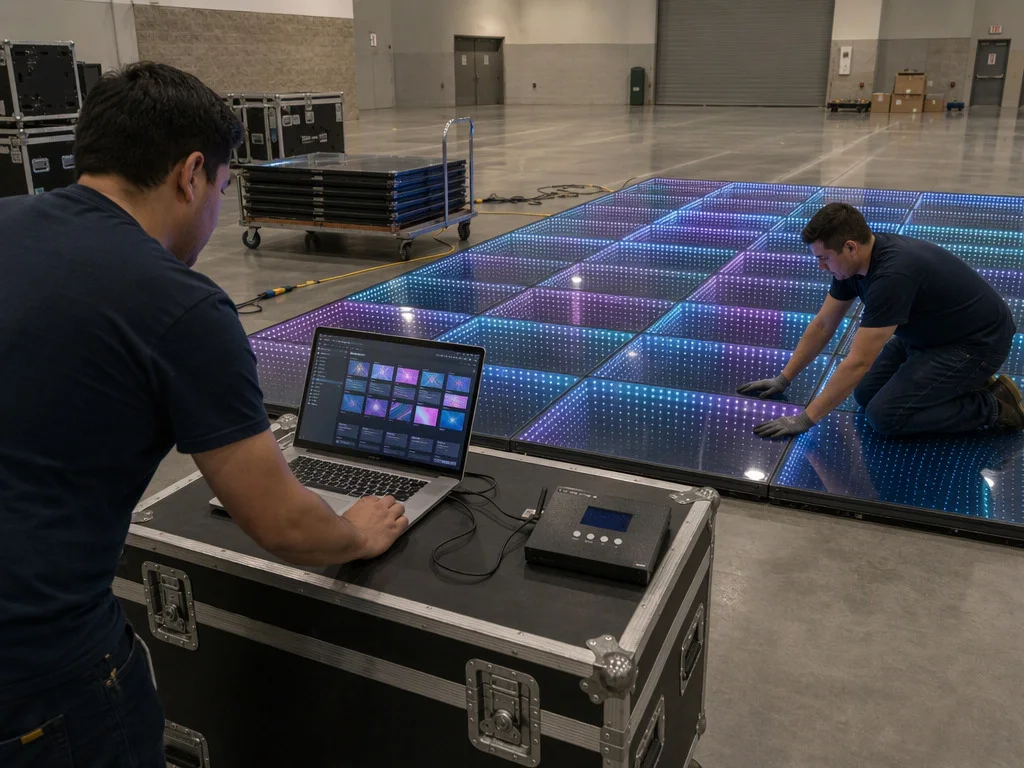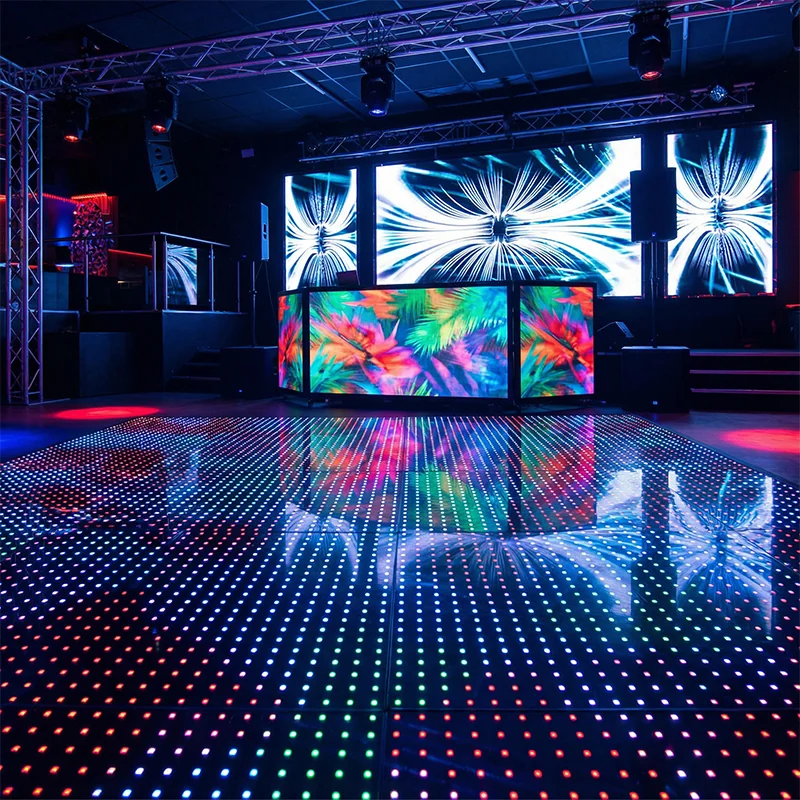
This guide covers RGB, mirror, starlight and programmable pixel lighting dance floors. Video display floors and interactive sensor floors are outside the current product range.
Pixel LED Dance Floor ROI: Branded Bookings, Programming and Payback
A pixel LED dance floor ROI calculation fails the moment you run it like a star floor calculation. The star model earns by going out more often, which is why its payback is a question of utilization. The pixel model earns by going out at a higher rate and by selling something the other floors cannot produce at all: the content that runs on it.
That second engine is the one most rental companies leave on the table. This guide works through both, using published rental references from the market, and shows where a pixel floor pays back faster than its price tag suggests and where it does not.
Two revenue engines, not one
Start with the metric that keeps the comparison honest. Dollar utilization divides annual rental revenue by the acquisition cost of the equipment, which is the standard way rental businesses judge whether capital is working hard enough [6]. Utilization rate, the share of available days that equipment is actually out, is the operational companion to it [7].
An effect floor improves both numbers by going out more often. A pixel floor improves them in two ways at once, and the second way is invisible in a simple rate card.
Engine | What drives it | What it depends on | Ceiling |
|---|---|---|---|
Rate at the branded end | The client's budget line | Whether the booking sits in a marketing budget rather than a decor budget | Higher than an effect floor, but still one number per event |
Programming as a product | Content built, delivered and maintained | Whether you price the work or give it away | Multiplies with every branded booking and every repeat client |
A floor that only pulls the first lever is competing with every other LED floor on rate. A floor that pulls both is selling a service that most competitors in a regional market cannot deliver, because they bought a floor without building a content capability behind it.
What a pixel floor costs
The Pixel page lists magnetic setup, an IP67 panel rating and a−40°C to 60°C operating-temperature statement. Its documentation labels are CE and RoHS, plus a CNAS laboratory reference; do not treat the laboratory reference as a separate product certification.
Cost figures in this section are planning examples from the article’s publication date.
For a rental company, the practical purchase bands are the ones already established for this category: an entry floor around $ 3,000, a good-quality rental floor in the $ 6,000 to $ 8,000 range, and higher again for a specialist model. Five things move you up or down inside that band.
The complete guide to the pixel dance floor covers the panel grid and the content workflow in more detail. DanceFloorLED's pixel model ships on 10mm tempered glass rated to 600-700kg per panel, with a magnetic no-tool build and control from a tablet, a PC, DMX512, a remote or WiFi [13].
What it earns: rates at the branded end
Published rental references for LED floors and the display screens that compete with them for the same budget line look like this.
Reference | Figure | What it covers |
|---|---|---|
Per square foot, US and UK event rental | From about $ 9 per square foot | Floor units as a base rental line [2] |
Complete event packages | $ 1,000 to $ 6,000 per event | Floor, delivery and setup as a package [2] |
Basic square setup | From about $ 1,800 | Entry point for a straightforward floor [1] |
Large fully customized installation | $ 30,000 and above | Custom builds at scale [1] |
Two things stand out. The package range of $ 1,000 to $ 6,000 covers most rental work, and the custom end runs an order of magnitude above it. That gap is not a pricing accident. It reflects what a branded build includes: more panels, a denser configuration, a control system configured for the event, content built and tested, and hardware that carries the client's identity [5].
The second thing is the corporate and wedding comparison. Published rental price lists put a corporate conference display above a wedding display of similar size [4], which is the clearest available evidence that corporate work sits in a larger budget pool. A floor that shows a sponsor logo at a product launch is competing for brand production budget, not for the money a couple allocates to decorating a reception.
For a rental company that already owns effect floors, the practical band to plan around is the one established across this product range: roughly $ 1,200 for a 12x12 ft floor, $ 1,600 for 16x16 ft, and $ 2,000 for 20x20 ft on standard work, with premium gala and branded events reaching $ 2,500 to $ 5,000 for a 16x16 ft and beyond that for larger custom builds [8][9][10][11]. The pixel floor does not change the mainstream band. It changes how much of your calendar can sit above it.
For a side-by-side view of how the types and specifications compare across the whole range, the 2026 LED dance floor buying guide sets types, specs and payback against each other.
Programming as a product
This is where the pixel floor separates itself from every other floor in a rental fleet, and where most operators leave money behind.
Photographers, event producers and clients do not buy LED panels. They buy a floor that says the client's name during the first dance, shows the sponsor logo during the award segment, and runs a countdown before the reveal. The panel is the delivery mechanism. The programming is the product.
How to price it
Three structures work, and the choice depends on how repeatable the work is.
Structure | When it fits | What it protects |
|---|---|---|
Included for repeat clients | A venue or planner you bill several times a year | Retention, and a reason not to shop the next event |
Per-event content fee | One-off branded bookings | Margin on the labour, with no ambiguity about scope |
Content pack as a one-time build, then a loading fee | Corporate clients with a recurring brand | A durable asset you re-rent with almost no labour |
The third structure is the one that changes the economics of the floor. Once a brand's content pack exists in your library, running it again is a loading task rather than a production task. The floor's rate stays the same and the labour collapses, which is exactly the mechanism that lifts dollar utilization without raising the rate card.
The content cost side
Content work is real labour, and pretending otherwise is how operators end up resenting the floor. The honest version is that the cost is front-loaded and then falls away.
Measure it in hours rather than in a wage rate, because your labour cost is yours to apply. A first branded booking involves gathering artwork, building the sequence to the floor's panel grid, testing it on site and getting sign-off. A repeat client with an existing pack involves loading and confirming. The difference between those two tasks is the entire argument for building a content library from the first branded job rather than treating each one as bespoke.
The floor itself makes this easier than a display wall does. Because the panels are a modular grid and the connection is magnetic, a floor can be laid out at a different size and shape for a different event while the content is re-authored to the new grid, which is a much smaller task than rebuilding a physical wall.
The payback math
Now the arithmetic that matters. The floor price is fixed. What varies is the rate you can hold and whether programming is billed.
Scenario | Floor rate per event | Programming | Gross per event | Events to pay back a $ 6,000 floor |
|---|---|---|---|---|
Mainstream band, programming given away | $ 1,600 | Included | $ 1,600 | 5 to 6 |
Branded rate, programming billed | $ 2,500 | Billed separately | $ 3,100 and up | 2 to 3 |
Large custom build | $ 5,000 and up | Billed as a project | $ 6,000 and up | 3 to 4 on a $ 20,000 build |
These are illustrative models built on the published references above, not a quotation, and your own labour and transport costs come off the gross before it becomes profit. The mainstream band still pays a floor back respectably. The branded band with a billed programming line does it in roughly half the events, and that difference compounds, because a shorter payback means the capital is free to buy the next floor sooner.
Sizing moves the rate band as much as the model does, and the dance floor size guide works through the sizes by guest count and dance area.
A note on the comparison with the star floor. Its payback arrives from volume, so a fleet that already runs a busy calendar may see a star floor return capital earlier in calendar terms. The pixel floor returns more per event and opens a client category the star floor cannot serve at all. A fleet holding both is not hedging, it is covering two different halves of the market.
Corporate versus wedding: why the budget changes
The same floor earns differently depending on whose budget is paying for it, and that is not a negotiating trick. It is a structural difference in how the two clients buy.
A wedding floor is a decor decision. It has to look right, but it competes for money against flowers, draping, lighting and the venue itself, and the buyer is spending their own cash. A corporate floor is a production decision. It shows a brand mark in a room full of press, staff and customers, and it competes for brand production budget alongside staging, screens and signage. Published rental price lists reflect that difference, pricing a corporate conference display above a wedding display of comparable size [4].
The practical consequence for a rental operator is that the pixel floor should be quoted on the booking type as well as the size. A 16x16 ft floor at a wedding and a 16x16 ft floor at a product launch are not the same job: one needs a look, the other needs a sequence with timings, brand colours and a test run. Pricing them identically leaves the second job underpaid, which is the most common way a pixel floor underperforms its own potential.
Breaking down a large custom build
The published reference point of $ 30,000 and above for a large fully customized installation [1] reads as a single number. It is really a stack of decisions, and knowing the stack is how you quote one.
Strip those away and the remaining floor is the same product as the rental unit. That is the useful insight for a rental buyer: the top of the published range is driven by configuration and one-off work, not by a fundamentally different panel.
When the pixel floor is the wrong buy
There is a version of this purchase that does not pay back, and it looks like a busy wedding calendar.
If your bookings are receptions, parties and school events, and no client has ever asked what could appear on the floor, then the content pipeline is a cost with no buyer. A star floor with 96 built-in effects covers that calendar at a lower price and needs no content work between events, which is why it outperforms on utilization in that specific setting.
The pixel floor becomes the right purchase at the moment branded work is already on the calendar or visibly in the pipeline: a corporate client asking for a logo on the floor, an agency briefing a launch, or a venue that wants its own mark on the surface for every event it hosts. Those are the bookings where the second revenue engine starts running, and they are the reason this floor exists in a rental fleet at all.
If you need the floor built to a specification that no stock model matches, the custom OEM program covers sizes, effects, patterns and printed branding from the factory rather than from a reseller.
FAQ
How much does it cost to rent a pixel LED dance floor?
Published rental references put LED floor units from about $ 9 per square foot, with complete event packages commonly landing between $ 1,000 and $ 6,000 per event [2]. A basic square setup starts around $ 1,800, and a large fully customized installation can run past $ 30,000 [1]. A pixel floor sits above the mainstream effect-floor band because corporate clients are buying it from a marketing budget rather than a decor budget.
How much more expensive is a pixel floor than a star floor?
Expect a higher purchase price and a higher rate per event. The star floor runs preset effects and needs no content work, so it wins on booking volume. The pixel floor carries a denser panel and a content pipeline, so it wins on rate per event. The premium buys access to branded work that an effect floor cannot serve at all.
Can I charge separately for content programming?
Yes, and you should. Rental companies already advertise programming services that match a client's branding or event theme [5], and published hire catalogues list the controller as its own line item [3]. Treating programming as a priced deliverable turns the cost of content work into a second revenue line, which is the main reason the pixel floor pays back faster than its purchase price suggests.
How long does it take to prepare content for one event?
For a straightforward event it is measured in hours rather than days: a logo or monogram sequence, a name display, and a short ambient loop built to the floor's panel grid. Repeat clients are fastest because their content pack already exists. Allow more time on a first branded booking, where artwork has to be gathered, tested on site and signed off.
How many bookings does a pixel floor take to pay back?
It depends on the rate band you can hold and how much programming you sell alongside it. A floor earning at the corporate end with a billed programming line reaches payback in fewer events than the same floor earning at the mainstream band with programming given away. The star ROI analysis works the same arithmetic from the volume side, and the abyss ROI guide does it from the premium side.
Why do corporate clients pay more than weddings?
Because the money comes from a different budget. Published rental price lists show corporate conference displays priced above wedding displays of comparable size [4], and corporate spend is allocated to marketing and brand production rather than to venue decoration. At a launch, the floor is a branded surface, so it competes for brand production money.
What is included in a large custom floor build that costs $ 30,000 or more?
When is a pixel floor the wrong purchase?
When your bookings are weddings, parties and school events with no branding requirement, and no client has ever asked what could appear on the floor. In that case a star or abyss floor earns more per dollar invested, because it carries no content pipeline. Buy the pixel floor when branded work is already on the calendar.
The two-engine test
Before you order, run one test. Count the bookings in the last twelve months where a client asked for a logo, a name or a message on the floor, or would have if you had offered it. If that number is zero, an effect floor is the better buy and the star versus pixel comparison will confirm it.
If that number is anything above zero, the pixel floor has a second revenue engine available that your current fleet cannot generate. Price the programming rather than absorbing it, build the content pack on the first branded job, and the floor pays back on both engines: a higher rate per event, and a service line that repeats.
DanceFloorLED builds the pixel LED dance floor for rental fleets and venues, with content control from a tablet, a PC, DMX512 or a handheld remote, and factory support for custom configurations in sizing, effects and printed branding. To scope a floor against your booking mix, the solutions team can work from your calendar and the contact page reaches them directly.
Sources
1. Angels Music. "Everything to Know About LED Dance Floor Rentals." angelsmusic.net, August 2025. https://angelsmusic.net/2025/08/05/everything-you-needed-to-know-about-led-dance-floor-rentals/ . Rental costs from around $ 1,800 for a basic square setup, up to $ 30,000 or more for large fully customized installations.
4. PartsLED. "LED Screen Rental Price List: How Much to Rent in 2026." partsled.com. https://partsled.com/led-screen-rental-price-list.html . Corporate conference display 16x9 ft at $ 1,800-$ 3,000 against a wedding display 9x12 ft at $ 1,200-$ 2,000.
5. iCelebrate Events. "Dance Floor Rentals in Menlo Park, CA." icelebrateevents.com. https://www.icelebrateevents.com/dance-floor-rental-in-menlo-park-ca/ . Rental operator describing programming of lighting effects to match a client's wedding palette, branding or event theme.
6. Ajelix. "10 Equipment Rental KPIs For Rental Business." ajelix.com. https://ajelix.com/bi/equipment-rental-kpis/ . Dollar utilization defined as annual rental revenue divided by total acquisition cost.
7. Rentman. "Equipment Rental KPIs." rentman.io. https://rentman.io/blog/equipment-rental-kpi . Utilization rate as the share of available days that equipment is rented out.
8. Event Brothers. "Dance Floor Cost: Prices by Size & Money-Saving Tips." eventbrothersco.com. https://eventbrothersco.com/dance-floor-cost/ . Rental rate range of $ 300-$ 1,500.
9. Torkay Events. "LED Light Up Dance Floor Rental." torkayevents.com. https://www.torkayevents.com/items/led_light_up_dance_floor_item/ . Size-based rental rates: 12x12 ft $ 1,200, 16x16 ft $ 1,600, 20x20 ft $ 2,000.
10. Beyond Tent. "Should Your Venue or Party Rental Business Invest in an LED Dance Floor?" beyondtent.com. https://beyondtent.com/blogs/beyond-tent-blog/should-your-venue-or-party-rental-business-invest-in-an-led-dance-floor . 16x16 ft rentals at $ 2,500-$ 5,000, up to $ 8,000-$ 10,000.
11. CEG Interactive. "LED Dance Floors." ceginteractive.com. https://ceginteractive.com/led-dance-floors/ . Per-square-foot pricing around $ 25 including setup and technician.
Note: Rental rates, purchase costs, payback figures and utilization examples in this article are industry estimates and market listings gathered from the sources above, not DanceFloorLED's official pricing. Manufacturer specifications are per DanceFloorLED's product pages. Content preparation time is expressed in hours so that operators can apply their own labour rate.