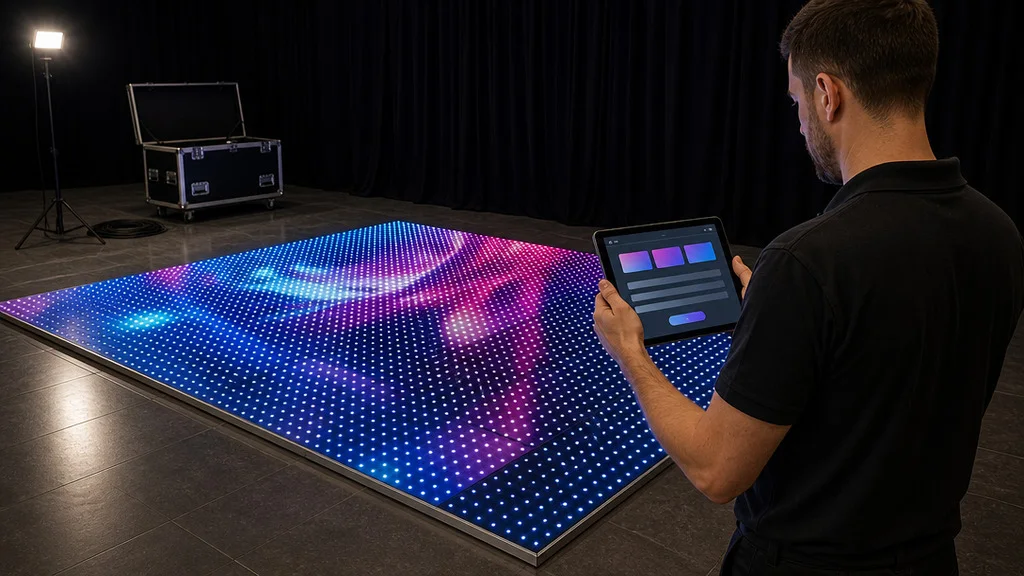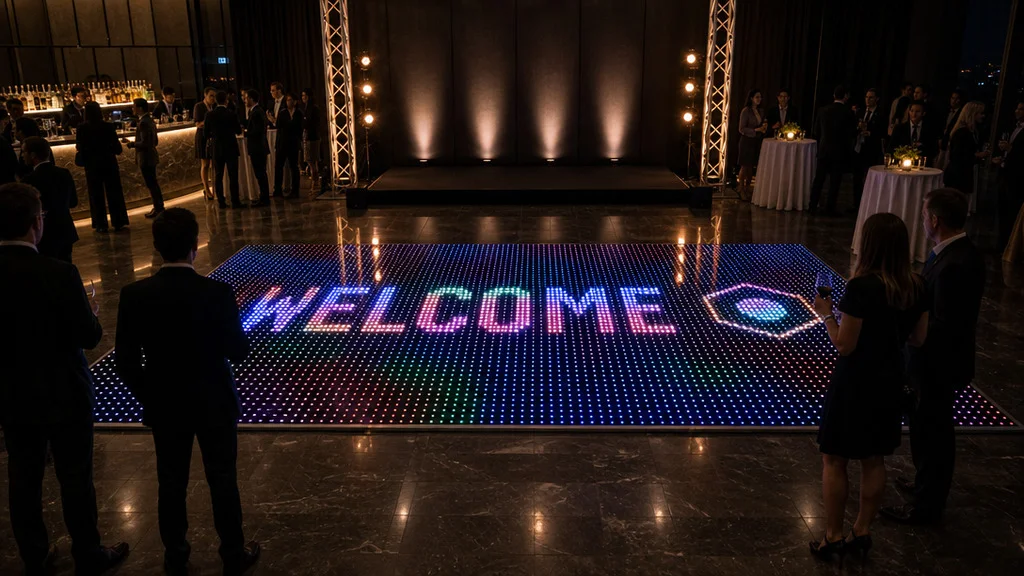
This guide covers RGB, mirror, starlight and programmable pixel lighting dance floors. Video display floors and interactive sensor floors are outside the current product range.
> Fact: DanceFloorLED has 13 years of LED dance floor manufacturing experience and has delivered over 100,000 sets with a 98%+ on-time delivery rate.
The defining feature is addressability. On a pixel floor, each point of light is controlled on its own, so the surface behaves as a low-resolution display. On an effect floor, the panel runs a preset look across its whole surface, and the operator chooses from a library instead of drawing anything new.
That single difference explains why suppliers also market these floors as a digital dance floor, and why the effect lists are so different. A preset floor advertises 96 effects. A pixel floor advertises the ability to display text, logos, monograms, patterns and animation, because the content is supplied rather than shipped.
It also explains the operational difference that buyers notice after the first booking. An effect floor goes out the door and comes back. A pixel floor needs a content step, a test step and an operator who knows the controller. The rest of this guide is largely about making that step cheap enough to be worth charging for.
Vendor specifications for floor tiles often quote viewing distances and viewing angles borrowed from wall screens. One published floor tile listing quotes a 5 to 50 m viewing distance with viewing angles of 160 degrees horizontal and 140 degrees vertical [5]. Those numbers describe a screen mounted vertically at eye level, which is not what a dance floor does.
A floor has three unusual viewing conditions at once. Guests look down at it from standing height, usually from two to five metres away. Cameras shoot it from above or from the edge of the floor. Much of the time it is seen at a glancing angle, partially blocked by the people standing on it. Detail that would read clearly on a wall disappears under those conditions, which is why content legibility, not raw pixel count, is the specification that decides whether a client is happy.
A pixel floor is judged on two things at once: what it shows, and whether it survives the schedule. The specification sheet answers both, but only if you read the right lines.
Specification | DanceFloorLED pixel LED dance floor | Why it matters in rental service |
|---|---|---|
Colors | 16.7 million, full RGB | Brand colours have to match, and gradients have to stay smooth |
Refresh rate | 2000Hz | Low refresh rates flicker on camera; this is what keeps phone and professional footage clean |
LED and output | SMD 5050, 120lm/W | Brightness has to beat ambient venue light while guests stand on the surface |
Lifespan | ≥50,000 hours | A fleet floor runs hundreds of events over its life |
Energy | 30% of traditional lighting fixtures | A large floor draws real power across a long event |
Walking surface | 10mm tempered glass | The display sits below the glass, not on the walking surface |
Load rating | 600-700kg per panel | Refer to the selected model’s load conditions; no vehicle-rollover approval inferred |
Sealing | IP67 | Handles spills and dust; see the limits below |
Temperature range | -40°C to 60°C | Covers cold marquees and hot summer venues |
Panel sizes and weight | 50 cm panel:11 kg;60 cm panel:14 kg. Total panel height is not restated in the Pixel detail page. | Panel weight sets how many cases and how many crew |
Rated power | Configured electrical demand to be specified; no confirmed per-panel 20 W basis | Multiply by panel count before you plan the venue circuits |
Connection | Magnetic, no tools | Assembly speed and on-site panel swaps |
Control | Tablet (iOS and Android), Windows PC, DMX512, remote, WiFi | Different operators need different interfaces |
Packaging | Wheeled flight case or carton | Rental fleets need the case |
The published refresh rate helps describe the Pixel lighting system, but camera results still depend on the recording setup. Assess any exceptional loading separately; the per-panel FAQ number does not establish vehicle wheel-load or rollover approval.
A pixel floor can display text, logos, monograms, patterns, ambient animation and branded sequences. That list is genuinely open, which is the problem: an open list means someone has to decide what goes on the floor, and that decision is usually made far too late in the planning.
Design for a low-resolution display seen from a distance at a glancing angle. Big single words work. Six lines of small type do not. High contrast works. Subtle tonal gradients disappear.
The practical version of this rule is that content is designed around moments rather than around a file. A WELCOME message at doors, a monogram behind the first dance, a sponsor logo during the awards, a countdown before the reveal. Each moment needs one clear graphic that reads in two seconds from across the room, and the sequence of moments matters more than the artwork quality.
Ask the client for six things and you can build the pack without a second meeting: the event name, any names that must appear, the logos and brand colours to use, the timings for each piece, the moments that must not be missed, and who signs off the artwork. That last item prevents the most expensive kind of rework, which happens when the person who approved the design was not the person entitled to approve it.
Control is the part buyers underestimate, because a floor with five control methods still needs one person who knows how to use them at the venue.
Control method | Who uses it | Typical situation |
|---|---|---|
Handheld remote | Venue technician or crew lead | Quick changes during the event, no laptop on site |
Tablet (iOS and Android) | Rental crew | Loading a client's content pack and running the show |
Windows PC software | Content producer | Building and testing the pack before the event |
DMX512 console | Lighting designer | The floor runs as part of the same show as the stage |
WiFi | Any of the above | Wireless control once the floor is laid and the venue is live |
Software in this class handles pixel mapping, which is the process of telling the controller how the physical panels are arranged so that content lands in the right place on the surface. MADRIX is the best known example in the lighting world, and its documentation walks through fixture configuration and output setup for LED installations [6]. DanceFloorLED's pixel floor supports PC software and DMX512, so it can be driven either by its own controller or from a console the client's lighting team already runs.
The fix is mechanical rather than creative. Ask the supplier for the panel grid and the resulting pixel dimensions of the floor before anyone opens a design file, and pass those numbers to whoever builds the content. DanceFloorLED calculates panel count and accessories from the floor area you specify, which is the point where you should also request the grid.
A content pack costs real time the first time and almost nothing after that. Save the pack against the client, name it by event and date, and keep the working files rather than only the exported output. On a repeat booking, a crew loads the pack, checks the artwork still matches the client's current branding, and runs a test.
Four checks belong on every job. Run the content on site rather than in the warehouse, because ambient light changes legibility. Look at the floor from the far side of the room, which is where the client's guests will form their impression. Check the floor on camera at the venue's lighting, since a 2000Hz refresh rate is what keeps footage clean. And confirm the display brightness reads against the room rather than washing out.
Floor size follows peak simultaneous dancers rather than total attendance, because guests cycle on and off through the evening. DanceFloorLED's sizing table pairs each size with both a dancer figure and a guest figure, and the two sit far apart on purpose.
Floor size | Dancers at once | Total guests served |
|---|---|---|
10x10 ft | 10-20 | 60 |
12x12 ft | 30-40 | 100 |
15x15 ft | 50-60 | 150 |
16x16 ft | 60-80 | 180 |
18x18 ft | 70-80 | 200 |
20x20 ft | 100-120 | 250 |
24x24 ft | 120+ | 400 |
Rental customers most often choose 20x20 ft or 16x16 ft. Size matters twice on a pixel floor: once for the crowd, and once for the canvas. A wider floor gives text and logos more room to sit at a readable scale, while a small floor forces content into fewer pixels and narrows what will work. For a fuller breakdown of how size follows the room, see the LED dance floor size and style guide.
Two layout points worth settling before the build. Wrap content around the walkable area rather than assuming the whole surface stays visible, since a dense crowd will cover the centre of the floor. And keep the content that must be seen at the edges, where guests, cameras and the room's sightlines still reach it.
The pixel floor's structure is what makes it a rental asset rather than a demo piece: the display sits under 10mm tempered glass, so the surface that takes foot traffic is glass rather than exposed LEDs.
A car-show application does not establish vehicle wheel-load or driving approval. Confirm the load distribution, base and complete installation for the intended use rather than deriving vehicle suitability from a per-panel number.
A car-show application does not establish vehicle wheel-load or driving approval. Confirm the load distribution, base and complete installation for the intended use rather than deriving vehicle suitability from a per-panel number.
IP67 is a defined rating rather than a marketing word: under IEC 60529 it means dust tight with protection against immersion [7]. On a dance floor that covers the realistic accidents, which are spilled drinks, cleaning, and dust at an outdoor or semi-outdoor site. DanceFloorLED adds protective covers at the connections and a protective box around the power supply for the same reason.
The limit is worth stating plainly, because the brand states it plainly. IP67 protects against spills, and the floor cannot be used outdoors in the rain. Rental operators in the market treat a pixel floor as an indoor product, and at least one US rental company lists its 20x20 ft pixel floor as indoor setup only [10]. Battery power makes the floor workable at sites without mains power, but it does not make it weatherproof.
Condition | Workable? | Note |
|---|---|---|
Indoor venue, dance traffic | Yes | The standard use case |
Spilled drinks and cleaning | Yes | IP67, with protected connections and power box |
Dusty site | Yes | IP67 covers dust ingress |
Site without mains power | Yes | Battery-powered magnetic panels |
Covered area, no direct rain | Confirm with supplier | Battery power helps, but treat weather exposure case by case |
Rain or standing water | No | The brand's own guidance rules out rain use |
Exceptional load assessment | Yes | 600–700 kg per panel in the FAQ; no vehicle-rollover approval inferred |
Panels connect magnetically without tools, so a failed panel can be lifted and swapped on site instead of taking the floor out of service. What you should settle at purchase is the spare policy: how many spares travel with a fleet, whether they are matched to the same LED batch so colours stay consistent, and who trains your crew on the swap before the first booking. Fleet operators who ask that question upfront are the ones who never have to explain a dark panel to a client.
DanceFloorLED makes four floors, and the pixel model is the only one that carries content. The other three are effect floors, which is a feature rather than a limitation once you look at how the booking calendar pays.
Model | What it does | Content work per event | Booking type |
|---|---|---|---|
Pixel | Displays custom text, logos and animation | Yes, per event | Corporate launches, trade shows, branded events, sponsor-led parties |
Star | 96 built-in effects over a starry pattern on a 3D mirror base | None | Weddings, parties, DJ sets, school events |
3D Abyss | Single continuous depth effect | None | Premium weddings, galas, nightclubs |
Abyss + Frosted | Mirror and frosted panels mixed for a rainbow read | None | Venues and clients wanting an unfamiliar look |
The rule that follows is simple. If clients ask for a logo or a message on the floor, you need the pixel model, and no effect floor substitutes for it. If clients ask for atmosphere, the star or abyss floor earns the same rate without a content step, which makes it cheaper to operate and faster to turn around. A fleet that holds both covers the whole market, which is the conclusion the star vs pixel comparison reaches from the opposite direction.
For the individual platforms, the star LED dance floor guide covers the preset effect library and the 3D abyss LED dance floor guide covers the depth effect, including the specs each floor is built to.
The cost buyers forget is the one that does not appear on the quotation. Content preparation is labour, and it happens before every branded event. Price it into the booking rather than absorbing it, because a floor that needs two hours of design work per job is a different business than one that needs none.
The reason the pixel floor still earns its place is where the money comes from. A branded floor is usually funded from a client's marketing budget rather than their decor budget, and marketing budgets are larger and less price sensitive. The floor stops being decor and becomes a display the sponsor pays for.
For a full payback model on a rental floor, including the rate ranges the market supports and the event count at which the floor covers its own purchase price, see the 3D abyss LED dance floor ROI breakdown. The platform economics carry across models, with the pixel floor adding the content step at the front and a higher rate at the back. If you need the floor built to your own specification, or branded to your fleet's identity, the custom LED dance floor OEM/ODM guide covers that process end to end.
The Pixel product page lists CE and RoHS labels and a CNAS laboratory reference. Its control list includes a compatible tablet, Windows software, DMX512 and remote control. Match the controller and documentation to the selected configuration.
Nine items, all of them written into the specification rather than agreed in conversation.
2. Refresh rate against your camera requirement
3. Glass thickness and load rating per panel, with the standard referenced
4. IP rating, and the supplier's statement of its actual limits
5. Control methods you need for the operators who will run the floor
6. Content workflow: who builds the pack, and what the panel grid is
7. Spare panel ratio, LED batch matching and the swap procedure
8. Packaging type and case count, for freight and vehicle planning
9. Certifications for your destination market
The Pixel page lists CE and RoHS, with CNAS wording retained as a laboratory reference. Match documentation to the exact supplied configuration and destination requirements; do not describe CNAS as another product certification. The buying guide and product overview provide the wider selection context.
A car-show application does not establish vehicle wheel-load or driving approval. Confirm the load distribution, base and complete installation for the intended use rather than deriving vehicle suitability from a per-panel number.
Treat it as an indoor product. The IP67 rating covers spills and dust [7], and the brand's own FAQ is explicit that the floor cannot be used outdoors in the rain. Battery-powered panels make it workable at sites without mains power, and a covered area with no direct rain can be workable, but rain and standing water are out. Confirm your specific site conditions with the supplier before you commit a booking.
Size follows peak simultaneous dancers, not total guest count, because guests cycle on and off the floor through the evening. DanceFloorLED's sizing table puts a 100-guest event on a 12x12 ft floor and a 250-guest event on a 20x20 ft floor. Rental customers most often choose 20x20 ft or 16x16 ft, and the larger floor also gives you a wider canvas for content.
DanceFloorLED supports tablet control on iOS and Android, Windows PC software for programming, DMX512 for integration with a professional lighting console, a handheld remote for quick changes, and WiFi. In practice the choice follows the venue: a technician wants the remote, a rental crew wants the tablet, and a lighting designer wants the console so the floor runs in the same show as the stage.
Because the panels connect magnetically without tools, a failed panel can be lifted out and replaced on site rather than taking the whole floor out of service. What you should settle at purchase is the spare ratio and the swap procedure: how many spare panels ship with a fleet, whether they are matched to the LED batch, and who walks your crew through a swap before the first booking.
It is worth it when clients ask for content, and only then. Corporate launches, trade shows and branded events specifically want a logo or a message on the floor, and no preset effect floor delivers that. For weddings, parties and DJ sets, the star floor's 96 built-in effects cover the job with zero content preparation, which makes it the cheaper floor to operate per booking.
Get the routine right and the pixel floor becomes the floor you quote when a client mentions a logo. Get it wrong and it becomes the floor that needs a designer at 6pm on a Saturday. DanceFloorLED builds the pixel floor on 10mm tempered glass with magnetic panels, supports tablet, PC, DMX512, remote and WiFi control, and confirms pitch, panel grid and accessories against your floor area. For fleet deployments, the solutions overview covers how that runs at scale, and the services page covers production, QC and order tracking.
Send your floor area, the content you need to display and your destination market, and you will have a configured quote within 2 hours.
6. MADRIX. "MADRIX 5 Documentation." https://help.madrix.com/. Manufacturer documentation covering fixture configuration and output setup for LED pixel mapping installations.
7. BND Test Equipment. "Understanding IEC 60529 Ingress Protection (IP Code) Certification Testing." 2024-08-28. https://www.bndtestequipment.com/industry-news/understanding-iec-60529-ingress-protection-ip-code-certification-testing/. Source for the definition of IP67 as dust tight with protection against immersion.
8. BSI / Intertek Inform. "BS EN 12150-1:2015 Glass in building. Thermally toughened soda lime silicate safety glass." 2015. https://www.intertekinform.com/en-us/standards/bs-en-12150-1-2015-211459_saig_bsi_bsi_500057/. Source for the properties and fragmentation behaviour that define thermally toughened safety glass.
9. DanceFloorLED. "Pixel LED Dance Floor" product page, specification, control and FAQ content, retrieved 2026-09-28. https://dancefloorled.com/pixel-dance-floor. Manufacturer specification source for panel weight, load rating, IP rating, refresh rate, control methods, certification and stated limits of outdoor use.
10. Epic Party Team. "Pixel LED Dance Floor, 20ft x 20ft" rental inventory listing. https://epicpartyteam.com/inventory/dance-floors/pixel-led-dance-floor-20ft-x-20ft/. Market reference for how rental operators position and site-restrict a pixel floor.