An outdoor LED dance floor project is not one specification question. It is three, because the word outdoor hides at least three different construction types, and they behave nothing alike. A floor laid for a single evening under a marquee, a floor built into a semi-permanent terrace, and a floor installed in a public square are the same panels in three entirely different engineering contexts. For the contractors, venue owners and large outdoor event organisers this article is written for, the questions that decide whether a project succeeds are load path, water management and power, not light output. The published product specification sets the starting point. Everything beyond it, especially permanent outdoor installation, has to be assessed by a qualified designer against local regulations.
Fact: DanceFloorLED has 13 years of LED dance floor manufacturing experience, has delivered over 100,000 sets with a 98%+ on-time delivery rate, and quotes within 2 hours with 24/7 English communication.
The first sorting question is duration, because duration decides how much engineering the site deserves before the floor is even quoted.
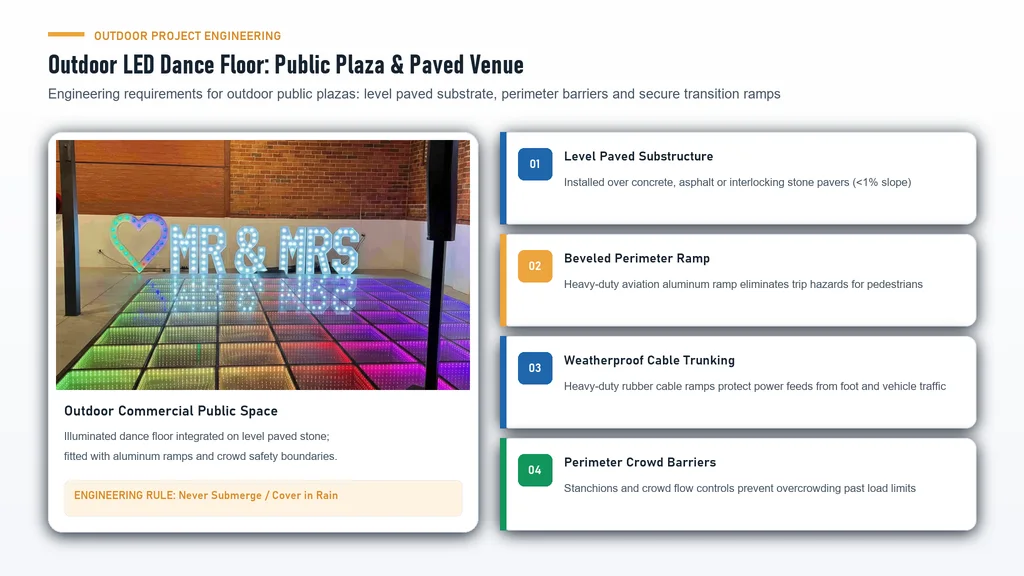
A temporary outdoor event floor lives for hours or a few days and is removed. The ground is whatever the venue already has, matting or a platform sits under the floor, and the concerns are assembly speed, levelness and getting the cable runs out of the way. A semi-permanent installation lasts weeks to a season and becomes part of the venue's fit-out, so it earns a prepared sub-base, measured levelness and mechanical restraint. A permanent public space installation is a built element of the site, with a designed base, designed drainage and a load path to the ground, and it is signed off by a project engineer and the local authority.
The panels are the same across all three cases. The requirement set is not, and a contractor who quotes one installation method for all three will under-engineer the permanent job and overspend on the temporary one.
Requirement | Temporary outdoor event | Semi-permanent installation | Permanent public space |
|---|---|---|---|
Typical duration | One evening to a few days | Weeks to a season, then removed or replaced | Years, installed as part of the site |
Ground condition | Existing hard surface, matting or a platform | Prepared sub-base, levelness measured | Engineered base, built into paving or landscaping |
Fixing and anti-displacement | Edge trim and barriers on a level surface | Mechanical restraint against movement | Structural tie-in designed by the project engineer |
Water and drainage | Run-off directed away, floor kept off standing water | Perimeter drainage and a designed fall | Site drainage designed into the scheme |
Power | Temporary generator or battery panels | Dedicated supply with protected distribution | Fixed supply installed to the site electrical design |
Weather exposure | Managed by site rules, covered where possible | Longer exposure, monitored | Continuous exposure across all seasons |
Who signs off | Event safety officer and site owner | Venue operator with a designer | Local authority and the project engineer |
Compliance | Event safety rules and the venue's electrical practice | Local building and electrical rules | Full local building, electrical and public safety rules |
The manufacturer publishes a set of specifications for the panels themselves. These are the numbers a contractor can put in a method statement, and they are also the numbers that must not be stretched beyond what is published.
Published specification | Value |
|---|---|
Water and dust sealing | IP67 panel rating; connector covers and power-supply enclosure require their own protection specification |
Operating temperature | -40°C to 60°C |
Load capacity | 600–700 kg per panel (product FAQ; loading conditions not specified) |
Walking surface | 10mm tempered glass |
Panel sizes and weight | 50 cm and 60 cm nominal panels;11 kg/14 kg where listed; total height is model-specific |
Rated power | Configured electrical demand to be specified; no confirmed per-panel 20 W basis |
LED and output | Use model-specific LED data; Pixel lists 5050 RGB,16.7 million colours,2000 Hz,120 lm/W andLED-source≥50,000 h |
Connection | Magnetic wireless, wired, or rechargeable magnetic (battery) |
Battery (optional) | Product-detail FAQs describe a 6000 mAh rechargeable option with a 2–3 hour charge time and approximately 10 hours of use. The range overview separately lists 26-hour and 36-hour configurations. Those are not established as the same battery pack, charging arrangement or controller; specify the chosen configuration and its runtime in the quotation. |
Control | Control options are model- and controller-specific. The Abyss page lists SD-card and PC control with Madrix compatibility, plus its other control options. Pixel lists Windows software, a compatible iOS/Android tablet, DMX512 and remote control. Star lists DMX, remote and controller options, with the undefined source term Voice. Do not assume every connection version supports the same controls or that Madrix runs on the listed tablets. |
Certification | Product-specific CE/RoHS labels; Abyss LVD/EMC report labels; CNAS laboratory reference, not a product badge |
Packaging | Wheeled flight case for rental fleets, or carton for fixed installation |
Two of these lines carry most of the weight on an outdoor project, and both need reading precisely.
IP67 is a defined rating, not a marketing word. Under IEC 60529, the first digit means the enclosure is dust tight and the second means it withstands immersion under defined test conditions [5]. That covers spilled drinks, cleaning and dust at a sheltered site. What it does not do is describe how water crosses a plaza, where it collects, or how a cable enters a distribution board in the rain. Water management on an outdoor floor is a civil and electrical design problem, and no panel rating solves it. A US rental listing for a 20x20 ft LED dance floor, for example, restricts the product to indoor setup, which is a fair market signal on how far this class of floor is normally taken into the open [9].
The surface and base must be assessed separately. Do not create a500–700 kg all-model rating or assume the source used a distributed-load test. Use the selected panel’s stated loading conditions and a base assessment appropriate to the project.
The product pages list IP67 panel ratings and 10 mm tempered glass. Connector covers, power-supply protection, operating-temperature limits and electrical demand must be specified for the selected model and installation; no unified load, power or environmental specification is inferred.
The full model range and the specification sheets behind these figures are on the LED dance floor range page, and a specific configuration such as the 3D abyss LED dance floor carries its own published detail. For the wider buying picture across parameters that matter to an engineering buyer, the complete 2026 LED dance floor buying guide sets out the specification dimensions in full.
Five checks cover most of the risk on an outdoor LED dance floor project. Do them before the quotation leaves your desk, not after the order is placed.
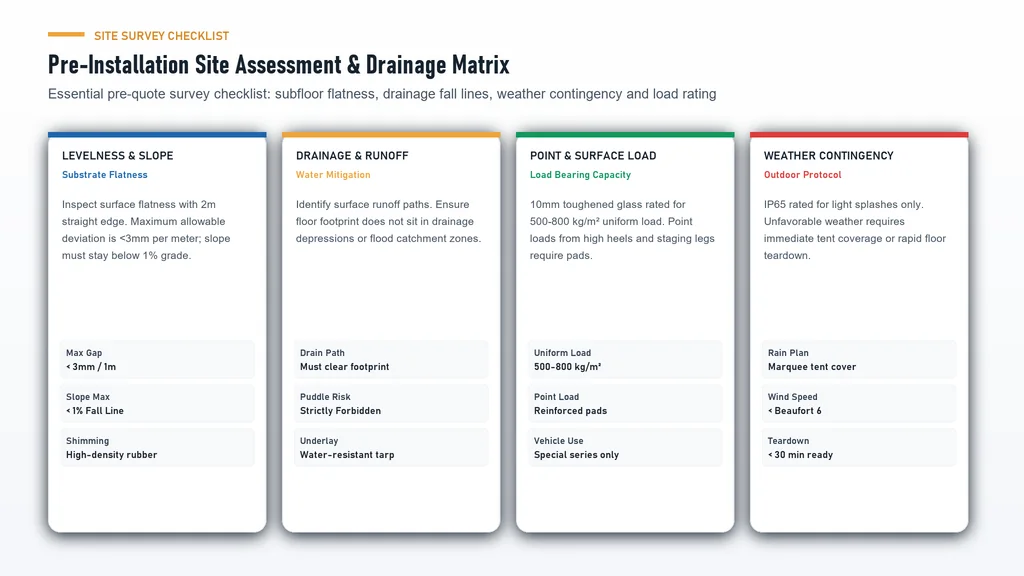
A panel floor built on magnetic connections wants a flat, stable surface. Measure levelness across the entire footprint rather than eyeballing the centre. Slope is the awkward one, because a fall for drainage and a level dance surface pull in opposite directions, and on a permanent or semi-permanent job the two are reconciled in the design rather than on site. Where the existing ground is uneven, the answer is usually a sub-frame or a platform, which changes the panel count and the method statement.
A floor lying in a puddle is a problem no matter what the panel rating says. Identify where water collects on the site, where it flows to, and how it leaves. On a temporary build, the practical answer is to direct run-off away and keep the floor clear of standing water, often by lifting it on a low sub-frame. On a permanent build, drainage is designed into the scheme. The point for a contractor is that drainage is a site decision made before the floor is specified, not a feature the floor brings with it.
Wind, crowd push and slope all try to move a laid floor. On a level temporary surface, edge trim and crowd barriers contain it. On a semi-permanent or permanent installation, movement is resisted by mechanical restraint and a structural tie-in designed by the project engineer. The magnetic connection is about assembly and on-site panel swaps, not about anchoring the floor to the ground, and the two should not be confused in a method statement.
A dance floor sits inside a crowd, so it has to respect the site's circulation. Keep emergency access and egress routes clear, set barrier lines where crowd pressure is highest, and think about how guests step on and off the surface, since a raised edge is a trip hazard if it is not trimmed or ramped. On a public space installation the floor is also part of the paving, so it has to meet the same access expectations as everything around it.
Outdoor projects are judged on ambient light in a way indoor ones usually are not. A floor in a public square competes with street lighting, illuminated signage and passing traffic, and a low-contrast effect that fills a dark hall can vanish outdoors. Check the ambient light at the time the floor will actually run, and confirm the effect reads against it. The published 120lm/W output and 16.7 million colour range give the floor the headroom to hold contrast [1], but the decision about which effect survives a bright plaza is a viewing decision, not a specification one.
Every outdoor floor needs power, and there are three paths. The right one follows the site, the event length and whether a supply already exists.
Power option | Best suited to | Points to plan |
|---|---|---|
Fixed mains supply | Permanent and semi-permanent sites | Weather-protected distribution sized from the confirmed configuration’s electrical schedule |
Temporary generator | Large temporary events | Load planning, cable routing, protection of connectors and leads |
Battery panels | Sites with no power, and short-duration events | Runtime against the intended effect, plus a charging plan for multi-day builds |
Use the electrical schedule for the selected panel, controller and power-supply configuration to plan demand. The 3D Abyss FAQ lists a 20 W rated-power figure without stating whether it is per panel or per system, so it cannot be multiplied by the panel count. Confirm the configured maximum and average demand before sizing distribution.
A temporary generator suits a large event with no permanent supply. It brings its own set of engineering tasks: load planning, running power to the floor without creating trip hazards, and protecting connectors and leads from water and from the crowd.
Product-detail FAQs describe a 6000 mAh rechargeable option with a 2–3 hour charge time and approximately 10 hours of use. The range overview separately lists 26-hour and 36-hour configurations. Those are not established as the same battery pack, charging arrangement or controller; specify the chosen configuration and its runtime in the quotation.
Whichever path applies, the installation side is not a do-it-yourself job. Generator sizing, distribution, earthing and the connection of a power supply all belong to qualified electrical personnel working to local regulations. On a public space floor the electrical design is part of the site's own compliance process.
Product-detail FAQs describe a 6000 mAh rechargeable option with a 2–3 hour charge time and approximately 10 hours of use. The range overview separately lists 26-hour and 36-hour configurations. Those are not established as the same battery pack, charging arrangement or controller; specify the chosen configuration and its runtime in the quotation.
Four questions on a permanent or long-exposure outdoor installation have no answer in a panel specification sheet, and they are the ones that decide the outcome.
Long-term weather and ultraviolet performance. The panels are rated for a temperature range and for ingress, but no weathering grade or ultraviolet resistance class is published for permanently exposed installation. No service life for continuous outdoor exposure should be assumed from the specification sheet.
Behaviour under prolonged immersion or standing water. IP67 defines protection against immersion under defined test conditions [5]. It is not a statement that an assembled floor can sit in standing water on a plaza.
Structural fixing and the load path for a specific site. How the floor is held down and how the load reaches the ground depends on the ground, the wind regime and the structure, and belongs to the project engineer.
Compliance with local electrical and public safety regulations. Rules differ by country and by site type, and the route to compliance is a local process, not a product feature.
DanceFloorLED publishes panel-level specifications. It does not publish a permanent outdoor installation rating, a weathering grade or a compliance opinion, and none of those should be invented on its behalf. On any permanent or long-exposure outdoor project, these four questions are resolved by a qualified designer for the specific site, against the local rules that apply there. Treat that as a requirement of the project, not an optional extra.
Once the site is assessed and the power path is chosen, four items carry an outdoor LED dance floor project from quotation to handover.
Drawings and a site survey. Get a measured survey of the footprint and produce a panel layout from it. The panel count follows the area, and for reference a 20x20 ft floor is 144 panels. The LED dance floor size and style guide covers how area converts to layout and panel count, which is the first thing to fix in writing.
Control options are model- and controller-specific. The Abyss page lists SD-card and PC control with Madrix compatibility, plus its other control options. Pixel lists Windows software, a compatible iOS/Android tablet, DMX512 and remote control. Star lists DMX, remote and controller options, with the undefined source term Voice. Do not assume every connection version supports the same controls or that Madrix runs on the listed tablets.
A maintenance and spares plan. Because panels connect magnetically without tools, a failed panel can be lifted and swapped on site rather than taking the floor out of service. What the plan needs to fix is the spare ratio, whether spares are matched to the same LED batch so colours stay consistent, and who trains the operator on a swap. On a permanent installation the plan also covers routine cleaning and a schedule for checking connections and covers.
Acceptance criteria. Agree what "done" means before handover: levelness of the finished surface, coverage of the whole footprint, the content or effects running as specified, control handed to a trained operator, and the site's safety routes clear. A short written acceptance list prevents the disputes that otherwise surface on the opening night.
DanceFloorLED supports this stage with its manufacturing and delivery process, from research and development through accessories, quality control and order tracking, which is set out on the manufacturing services page. For fleet-scale or multi-site outdoor rollouts, the event solutions overview covers how deployment is coordinated.
Use this table as the working brief for an outdoor LED dance floor project. Fill the middle column, and treat every blank as an open question rather than a default. It is written to be copied into a quotation pack.
Requirement | Notes |
|---|---|
Site type (temporary, semi-permanent or permanent) | Duration decides the engineering level |
Footprint area and panel count | Confirm from a measured survey |
Ground condition and measured levelness | Record slope and any sub-frame needed |
Drainage and standing-water risk | State where water collects and where it leaves |
Fixing and anti-displacement method | Edge trim, restraint or structural tie-in |
Power source and available capacity | Mains, generator or battery; total draw from panel count |
Battery runtime required | Match to effect, brightness and event length |
Control method and named operator | Choose from the six control options |
Weather exposure and cover | Marquee, canopy or open exposure |
Designer responsible for sign-off | Names the party confirming weather, fixing and compliance |
Spares and maintenance plan | Spare ratio, LED batch matching, swap procedure |
Acceptance criteria | Agree before handover |
Not as a free-standing product in open rain. The panels carry an IP67 rating, which covers dust and protection against immersion [5], but a floor on a plaza in active rainfall also depends on site drainage, cabling and cover, none of which a panel rating controls. On a temporary outdoor event, keep the floor under a marquee or canopy and keep it clear of standing water. For a permanent outdoor installation, the weather performance of the assembled floor has to be confirmed by a qualified designer against local regulations, because the manufacturer publishes panel-level ratings, not a permanent outdoor installation rating.
IP67 is a defined ingress protection rating. Under IEC 60529, the first digit means the enclosure is dust tight and the second digit means it withstands immersion under defined test conditions [5]. On a dance floor that covers spills, cleaning and dust at a sheltered outdoor site, and DanceFloorLED adds protective covers at the connections and a protective box around the power supply for the same reason. IP67 describes the panel, not the whole site. It does not tell you how water moves across a plaza, and it is not a statement that the floor can be operated in open rain.
Product-detail FAQs describe a 6000 mAh rechargeable option with a 2–3 hour charge time and approximately 10 hours of use. The range overview separately lists 26-hour and 36-hour configurations. Those are not established as the same battery pack, charging arrangement or controller; specify the chosen configuration and its runtime in the quotation.
That decision is not one the product specification answers. The published ratings describe the panels. A permanent outdoor installation introduces long-term ultraviolet exposure, continuous weather cycling, structural fixing and a load path to the ground, and compliance with local electrical and public safety rules. DanceFloorLED does not publish a weathering grade or a service life for permanently exposed installation, so no such figure should be assumed. Treat permanent outdoor use as a designed installation: have a qualified designer confirm weather performance, fixing, drainage and compliance for the specific site before you commit.
Five checks cover most of the risk. Measure levelness and slope across the whole footprint, because a magnetic floor wants a flat, stable surface. Identify where water collects and how it leaves the site. Decide the fixing method against wind and crowd movement. Map crowd flow and keep emergency routes clear. And check ambient light, because a public space floor competes with street lighting and signage. Record all five before you write a method statement, and use the fillable checklist above.
The panels connect magnetically without tools, which handles assembly speed and on-site replacement. Holding a laid floor against wind, slope and crowd push is a separate question, and it is answered by the site rather than by the panels. On a level temporary surface, edge trim and barriers contain the floor. On a semi-permanent or permanent installation, mechanical restraint and a structural tie-in designed by the project engineer are required. DanceFloorLED does not publish a fixing or tie-down specification for outdoor sites, because the correct solution depends on the ground and on local wind and structural rules.
Use the electrical schedule for the selected panel, controller and power-supply configuration to plan demand. The 3D Abyss FAQ lists a 20 W rated-power figure without stating whether it is per panel or per system, so it cannot be multiplied by the panel count. Confirm the configured maximum and average demand before sizing distribution.
A car-show application does not establish vehicle wheel-load or driving approval. Confirm the load distribution, base and complete installation for the intended use rather than deriving vehicle suitability from a per-panel number.
An outdoor LED dance floor project succeeds or fails on three things: the base, the water and the power. Decide which of the three outdoor types you are building, because a temporary event, a semi-permanent installation and a permanent public space floor ask for completely different levels of engineering. Use the published specification as the floor's own limits, not as a site conclusion. Then resolve the questions the specification does not answer, weather performance, fixing, drainage and compliance, through a qualified designer and the local rules that apply.
Scope an outdoor request against the product FAQ, the site and the selected full configuration before committing a booking. Panel-level IP67 and battery options do not establish rain operation, a range-wide temperature window or a new merged load rating. The solutions and services pages support project planning and order discussions.
1. DanceFloorLED. "LED Dance Floor" product range and specification pages, retrieved 2026-10-14. https://dancefloorled.com/led-dance-floor. Manufacturer specification source for panel size and weight, glass thickness, load rating, IP rating, operating temperature, rated power, control methods, battery options, certification and installation figures.
2. DanceFloorLED. "3D Abyss LED Dance Floor" product page, retrieved 2026-10-14. https://dancefloorled.com/3d-abyss-led-dance-floor. Manufacturer specification source for a specific configuration referenced in the article.
3. DanceFloorLED. "Solutions" and "Services" pages, retrieved 2026-10-14. https://dancefloorled.com/solutions and https://dancefloorled.com/services. Manufacturer source for deployment support, accessories, quality control and order tracking.
4. European Commission, EUR-Lex. "Directive 2014/30/EU on the harmonisation of the laws of the Member States relating to electromagnetic compatibility" and "Directive 2014/35/EU on the harmonisation of the laws of the Member States relating to the making available on the market of electrical equipment designed for use within certain voltage limits." https://eur-lex.europa.eu/eli/dir/2014/30/oj and https://eur-lex.europa.eu/eli/dir/2014/35/oj. Regulatory source for the EMC and Low Voltage directives behind the CE marking referenced by the manufacturer.
5. BND Test Equipment. "Understanding IEC 60529 Ingress Protection (IP Code) Certification Testing." 2024-08-28. https://www.bndtestequipment.com/industry-news/understanding-iec-60529-ingress-protection-ip-code-certification-testing/. Source for the definition of IP67 as dust tight with protection against immersion under defined test conditions.
6. BSI / Intertek Inform. "BS EN 12150-1:2015 Glass in building. Thermally toughened soda lime silicate safety glass." 2015. https://www.intertekinform.com/en-us/standards/bs-en-12150-1-2015-211459_saig_bsi_bsi_500057/. Source for the properties and fragmentation behaviour that define thermally toughened safety glass.
7. UK Health and Safety Executive. "The event safety guide (HSG195)." https://www.hse.gov.uk/pubns/books/hsg195.htm. Government guidance source for the allocation of safety responsibilities and the treatment of temporary structures and crowds at events.
8. International Electrotechnical Commission. "IEC 60529:2013 Degrees of protection provided by enclosures (IP Code)." https://webstore.iec.ch/publication/2452. Standard source for the IP code framework referenced in this article.
9. Epic Party Team. "Pixel LED Dance Floor, 20ft x 20ft" rental inventory listing. https://epicpartyteam.com/inventory/dance-floors/pixel-led-dance-floor-20ft-x-20ft/. Market reference for how rental operators position and site-restrict LED dance floors.