LED Dance Floor Maintenance and Troubleshooting: A Fleet Operator's Guide
If you run a rental fleet or a fixed venue, the question that matters is not how a floor performs in a showroom but how many events it delivers before something stops working. A well-kept LED dance floor is a low-maintenance asset: a sealed panel with a tempered glass face, no moving parts and a long LED life. Most of what looks like a breakdown, however, is not a component failure at all. It is a loose connection, a disturbed waterproof cap, a cable fault or a power issue that the crew can clear in five minutes on site.
This guide is written for operators who already own panels and want them to last through a season. It covers the daily care routine, transport and storage, an inspection cadence you can run after every event, a tiered troubleshooting sequence that works from the outside in and from power to signal, the spare parts worth holding, and the point at which a panel must be taken out of service and the factory called.
Fact: DanceFloorLED has manufactured LED dance floors for 13 years, has delivered over 100,000 sets worldwide, reports a 98%+ on-time delivery rate, and records years of zero major after-sales complaints across its rental and venue customers.
Why maintenance is a revenue decision
A dance floor earns money by being available, and every hour it is out of service is an hour it cannot be booked. Two failures cost more than they look like they do on paper.
The first is a fault on event night. A panel that goes dark in the middle of an event cannot be renegotiated with the client afterwards; it becomes a credit, a lost repeat booking, or both. The second is gradual decline in appearance. A floor with clouded glass, scuffed edges and mismatched panels stops justifying the premium rate, and the operator discovers the problem only when a planner chooses someone else.
Both are managed the same way, by a short and repeatable routine. The panels are modular, so a single spare turns a mid-event failure into a five-minute swap, and the connections are designed to be reseated by hand, which is where the fault often sits.
The product pages list 10 mm tempered glass and IP67 panel ratings. LED colour, refresh rate, electrical demand and controller features are model-specific. Connector covers and the power-supply box are separate protective components, not automatically IP67-rated by the panel statement.
Daily care after every event
The routine below takes a small crew a few minutes per floor and prevents the majority of faults that reach the factory.
Cleaning the 10mm tempered glass surface
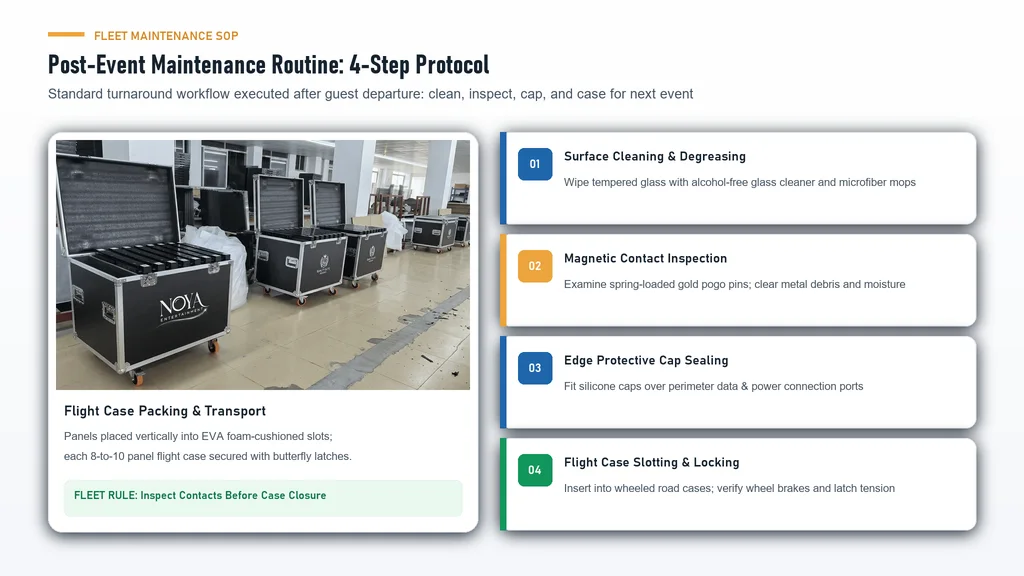
The dance surface is tempered glass, so it tolerates heavy foot traffic but not abrasion. Clean with a soft microfibre cloth or a soft mop and a mild, neutral cleaner, then dry the surface. Most surface damage has one of two causes. Grit does the visible harm: sand and small stones carried in on shoes act like sandpaper underfoot and scratch the glass, so sweep or vacuum before any wet wipe. Chemistry does the slow harm: abrasive powders, scouring pads and aggressive solvents such as ammonia-based or acetone-based cleaners attack the surface and the edge sealing over time.
Never pressure-wash a panel. High-pressure water is the exact opposite of what a sealed panel needs, because it drives liquid past the seals the IP67 rating depends on. For the same reason, do not leave panels standing in water or soaked. A damp cloth is fine on the glass; pooling water at the edges is not.
ABS housing and edge frames
The ABS housing and the frames take the handling damage that the glass does not. Wipe the housing down as part of the same pass, then look along the edges and corners for cracks, splits or lifted frame sections. A cracked housing is not only cosmetic: it is where moisture and dust get in. Check the frame alignment too, because a frame that has been knocked out of true will not seat cleanly against the next panel and shows up as a visible seam on the finished floor.
Connection waterproof caps and the power box
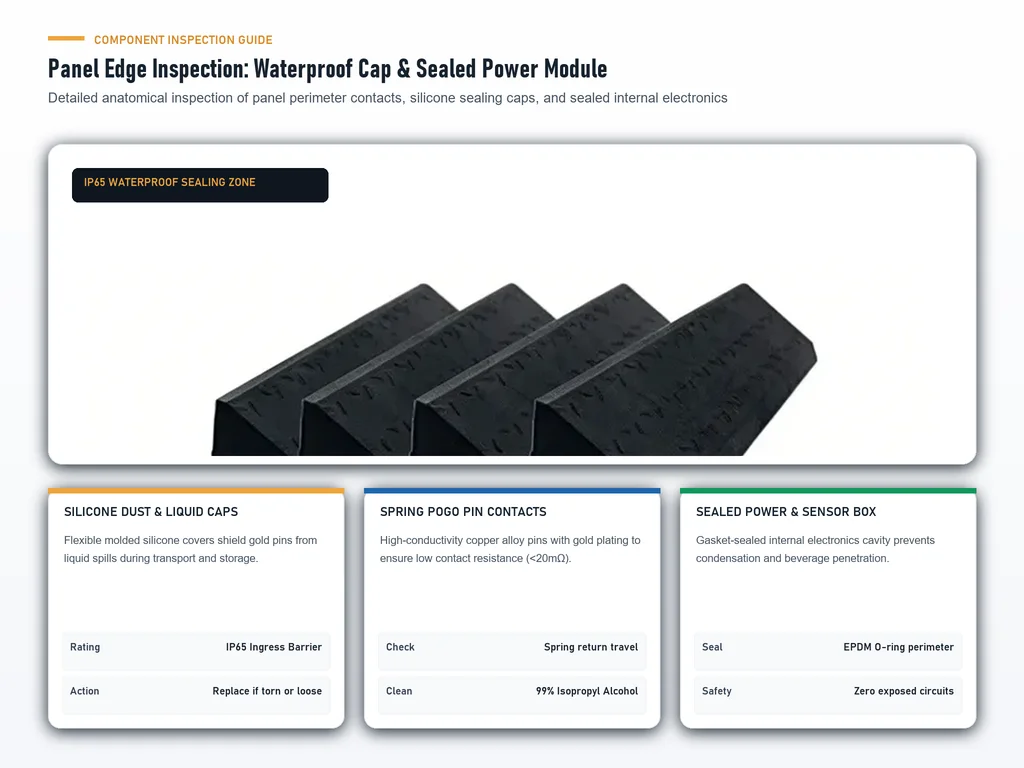
This is the part of the routine operators skip and should not. Every connection point on a sealed panel is fitted with a waterproof protective cap, and the power supply sits in a protective box. After each teardown, check that every cap is present, clean and correctly reseated, and inspect the power box for moisture, grit or damage. A cap left open or seated at an angle is the most common route for water to reach a connector.
Do not use the panel IP rating as permission for outdoor rain, standing water or soaking. Follow the product FAQ’s operating restriction, protect connections and power equipment as specified, and isolate affected equipment if water has entered it.
Transport and storage: flight case versus carton
Panels spend most of their life in transit and in storage, and that is where most handling damage happens. DanceFloorLED ships two packaging options, and the choice changes how a fleet should treat the kit.
Packaging | Best for | Handling notes |
|---|---|---|
Flight case (built-in wheels) | Rental fleets and touring | Built for rental use, rolls as a single unit, and protects panels through repeated loading; load and unload by case, not by hand |
Carton box | Fixed installations and lighter use | Light and economical, but slower to work from and less protective once opened; keep the original carton for storage |
For a rental fleet the flight case is the working default, because it turns a stack of panels into one rollable asset and cuts both setup time and edge damage. A carton suits a venue whose floor is installed once and left in place.
Three rules keep both packaging options working. Store dry, ideally at ground level where lifting damage is avoided, and away from damp walls and floors: panels and cases that live in a damp lock-up age faster than the panels themselves warrant. Stack flat, inside the case, and never stack beyond the case's design or place heavy gear on top of a carton. Finally, protect against humidity where you can, with a dry room or desiccant packs in the case, particularly in humid or coastal climates where condensation forms as temperatures swing. The panels are rated for an operating range of -40°C to 60°C, but storage in a dry, stable environment is what protects the electronics and connectors between seasons.
The inspection checklist and cadence
A short checklist run at two moments catches almost everything before it reaches a client: after each event, and at the start of each season or after long storage.
Check | When | What to look for | Pass criteria |
|---|---|---|---|
Glass surface | After every event | Scratches, chips, clouding, sticky residue | Clean, with no chips at the edges |
Housing and frames | After every event | Cracks, lifted frame sections, misalignment | Housing intact, frame sits true |
Waterproof caps and power box | After every event | Missing, dirty or mis-seated caps; moisture in the box | Every cap present and seated, box dry |
Connectors and contacts | After every event | Bent contacts, dirt, corrosion on the connection points | Clean and straight, no corrosion |
Panel test | Before dispatch and after storage | Every panel lights in a bench or batch test | All panels light, with matching colour |
Case condition | After every event | Damaged wheels, broken catches, split seams | Case closes and rolls safely |
Stock count | Before dispatch | Missing panels, missing spare, missing caps | Full kit plus one spare panel |
Run the panel test as a batch rather than trusting the last event's result. A single dead panel found on the bench is a replacement; the same panel found on site is a client-facing failure.
Troubleshooting: work from the outside in, power before signal
When something goes wrong, resist the instinct to open a panel. Nearly all panels are sealed units, and the faults an operator can clear live outside the housing, in the connections, the cables, the controller and the power path. Work in a fixed order and the diagnosis usually takes minutes rather than a return trip.
Two rules come before any diagnosis, and they are not negotiable. Never open a sealed panel, never work on a live circuit, and never bypass a protection circuit such as the short-circuit and overheat protection built into the dedicated power supply. Those protections exist to stop a fault becoming a fire, and defeating them turns a repair into a hazard. Everything in the third column below is safe for a trained operator; anything beyond it belongs with the factory.
The order is: check the outside first (connections, caps, cables), then the internal path (power before signal). Move a suspect panel to a known-good position on the floor. If the fault follows the panel, the panel is the problem; if the fault stays with the position, the issue is in the connection, cable or controller feeding it.
Symptom | Likely cause | Operator self-check | When to contact the factory |
|---|---|---|---|
One panel will not light up | Poor connection, open waterproof cap, or panel fault | Reseat both connections by hand, check the cap is clean and fully seated, then swap the panel to a known-good position | Fault follows the panel after a clean reseat and swap |
Localised flicker or colour mismatch on one panel | Loose or contaminated connector, damaged cable | Reseat the suspect connection, inspect the cable and contacts for dirt or damage, test the panel in another position | Flicker persists on a known-good connection |
A section goes dark after assembly | A single mis-seated connection breaking the run, or a power path fault | Walk the run from the controller outward, reseat each connection in turn, confirm the power box is seated and dry | The section stays dark with all connections confirmed |
Controller not responding | Loose control cable, wrong input selected, or controller fault | Check the control cable at both ends, confirm the correct input or source is selected, power-cycle the controller | No response after reseating and confirming the correct input |
Remote control not working | Flat battery, blocked line of sight, or pairing | Replace or charge the battery, confirm the remote is aimed within its working range, re-pair the remote | A spare remote also fails to control the floor |
Panels light but the effect is wrong | Wrong mode or source, or content file issue | Confirm the mode and source, reload the effect or content, test with a known-good file or the built-in library | The same source behaves differently across floors |
Battery panels will not run for the expected time | Charge state, effect brightness, or temperature | Fully charge the pack, run a lower-intensity effect, retest at room temperature | Runtime falls far short of normal on a full charge |
Two of those rows are judgment calls rather than faults. Battery runtime varies with brightness, effect and temperature, so a shorter run on a cold night with a bright effect is expected rather than a defect. And an effect that looks wrong is often a source or mode setting, which is why reloading a known-good file is the quickest test available to an operator.
Spare parts and consumables to stock
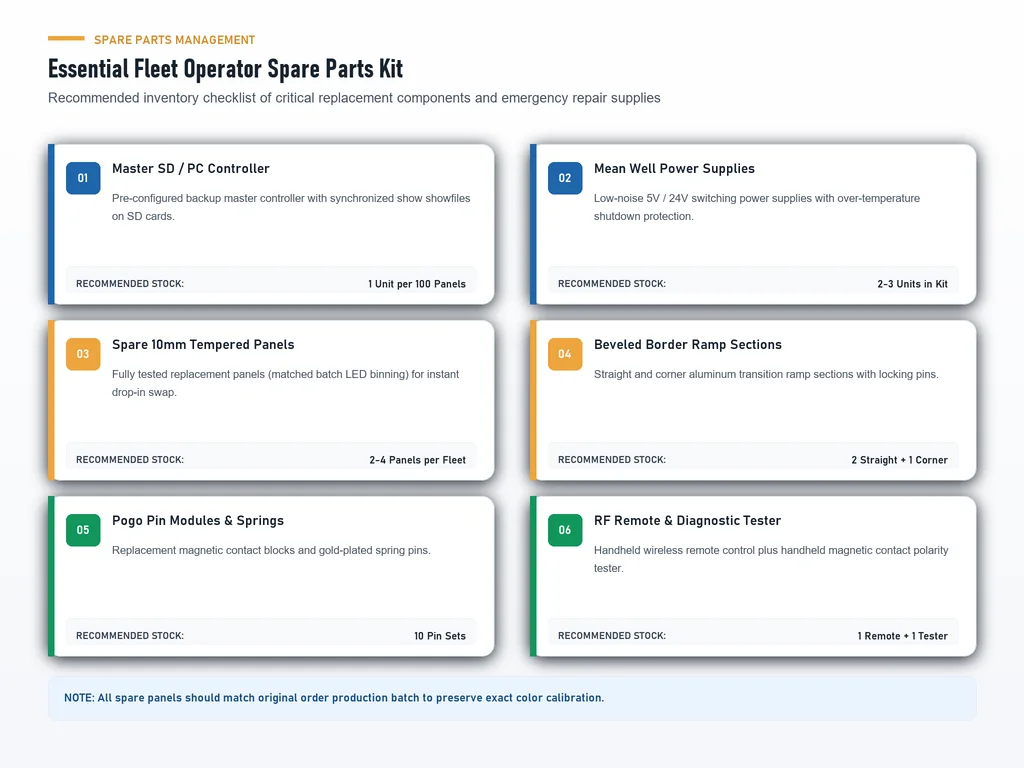
A fleet is only as resilient as its spares. The items below are the ones DanceFloorLED supplies and the ones that turn a fault into a same-day fix.
Item | What it is for | Suggested reserve for a fleet |
|---|---|---|
Controller | Drives the effects and runs the floor | One per floor type in use |
10mm tempered glass panel | Replaces a chipped or cracked panel | One spare panel per floor, sized to the largest floor |
Dedicated power supply (short-circuit and overheat protection) | The dedicated supply designed for the panel | One spare unit per floor |
Wireless frame | The quick-connect frame used on magnetic floors | A few spare sections for the most-used edge lengths |
Wired frame (dual-line, power and control separated) | The frame for permanent or wired installations | Matched to installed floors |
Remote control (50m range) | Hand control for effects on site | One per floor, plus one spare |
Consumables | Microfibre cloths, soft mop, mild neutral cleaner, desiccant packs | Restocked each season |
A single spare panel and a spare remote cover the two faults most likely to reach a client on site. Everything beyond that is about speed: the closer your spares are to the floor's configuration, the shorter the gap between a fault and a fix. Sizing a spare to the largest floor you operate is deliberate, because the spare then fits every floor in the fleet rather than one of them.
Fact: DanceFloorLED supplies its floor components individually, including controllers, 10mm tempered glass panels, dedicated power supplies with short-circuit and overheat protection, wireless and wired frames, and remote controls, so a fleet can stock exact spares rather than replacement floors.
When to stop using a panel and contact the factory
Some faults are not operator-serviceable, and continuing to use a panel in that state risks both the asset and the people on it. Take a panel out of service and contact the factory when you find any of the following.
A cracked, chipped or shattered glass face, or a glass face that has separated from the housing
Visible water inside a panel, or a panel that has been submerged
A burning smell, discoloration, melted plastic or heat damage at a connector or the power box
Exposed conductors, a damaged cable jacket, or any sign of arcing
A panel that repeatedly trips or overheats its power supply, or that runs hot compared with the rest of the floor
A panel that fails after a clean reseat, a swap to a known-good position and a known-good connection, which isolates the fault inside the sealed unit
In each of these cases, isolate the panel from power and store it aside rather than leaving it in the working stack, where it can be picked up by mistake on the next dispatch. DanceFloorLED's manufacturing and support services cover technical support and repair or replacement, and the contact page reaches the factory directly.
The after-sales path for a fleet
For a fleet operator, the value of a manufacturer is measured the moment something breaks, not the moment of purchase, and three things decide whether that moment goes well.
Reachability comes first. DanceFloorLED provides 24/7 English-language communication, so a fault raised during a late event night is answered rather than queued until office hours. Then the service itself, technical support plus repair and replacement, backed by the spares list above so that a failure becomes a swap rather than a stalled booking. Behind both sits the record: years of zero major after-sales complaints across rental and venue customers is the track record a fleet wants from the company it depends on.
Order progress is also tracked through six documented stages, from order to delivery, with video updates through testing, packing and dispatch. That matters operationally when a fleet is adding panels mid-season, because a live view of production and dispatch is easier to plan around than an estimate.
FAQ
How often should I clean an LED dance floor?
Clean the glass surface after every event, before panels go back in the case, because grit left on the surface scratches under the next load. Beyond the per-event wipe, run the full inspection checklist, including the connector test, at the start of each season or after any period of storage. Cleaning is a short task, and the cost of skipping it shows up as surface damage rather than as a single dramatic failure.
Can I use a pressure washer or a floor-scrubbing machine on the panels?
No. A pressure washer drives liquid past the seals that the IP67 rating depends on, and a machine with an abrasive pad works against the glass surface. Clean with a soft microfibre cloth or soft mop and a mild neutral cleaner, then dry the surface. IP67 protects against dust and temporary immersion under defined conditions; it is not a licence to wash the floor with a jet or leave panels standing in water.
Is an IP67 LED dance floor safe to leave outdoors or out in the rain?
The original product page lists an IP67 panel rating. Connections and the power supply need their own specified protection; the panel rating does not establish the weather suitability of the whole installation. The product FAQ excludes outdoor use in rain, and battery power does not change that restriction.
What spare parts should a rental company keep in stock?
At minimum, one spare panel sized to your largest floor, one spare remote control, and one spare dedicated power supply per floor. Add controller units per floor type and spare frame sections for the edge lengths you use most. A spare panel and a spare remote cover the two faults most likely to reach a client, and sizing the spare to the largest floor means it fits every floor in the fleet.
One panel is not lighting up. How do I tell whether it is the panel or the connection?
Move the suspect panel to a position you know works, with a connection you know works. Reseat both connections by hand, and check the waterproof cap is clean and fully seated, before you test. If the fault moves with the panel, the panel is the problem and it should be taken out of service. If the fault stays with the original position, the issue is in the connection, cable or controller feeding that position.
The controller or remote has stopped responding. What should I check first?
For the controller, check the control cable at both ends, confirm the correct input or source is selected, and power-cycle the unit. For a remote, replace or charge the battery, confirm you are within its working range and line of sight, then re-pair it. If a spare remote also fails to control the floor, the fault is upstream in the floor or the controller rather than the handset.
How should I store LED dance floor panels between events?
Store them dry, at ground level where possible, and flat inside the case rather than stacked on top of it. Keep them away from damp walls and floors, and control humidity with a dry room or desiccant packs in humid or coastal climates, where condensation forms as temperatures swing. Never stack beyond the case's design or place heavy gear on a carton. The panels are rated for a -40°C to 60°C operating range, but a dry, stable storage environment is what protects the electronics and connectors.
When should I take a panel out of service and contact the manufacturer?
Any cracked or separated glass, visible water inside a panel, a burning smell or heat damage, exposed conductors, or a panel that repeatedly trips its supply should be isolated from power and taken out of service immediately. So should a panel that still fails after a clean reseat, a swap to a known-good position and a known-good connection, because that isolates the fault inside the sealed unit. Never open a sealed panel, work on a live circuit, or bypass a protection circuit; those steps belong with the factory.
Keep the fleet working
The floors that last longest are not the ones that never see a fault; they are the ones whose operators built a routine around them. Clean the glass and the housing after every event, reseat the waterproof caps and check the power box, store dry and flat, run the checklist at the start of each season, and work faults from the outside in and from power to signal. That sequence clears most of what looks like a breakdown, and it tells you clearly when a fault belongs with the factory instead of the crew.
DanceFloorLED supplies lighting dance floors for rental and venue use, with model-specific panel, power/control, protection and packaging options. Compare Star, Abyss and Pixel for their visual effects, and plan maintenance around the exact system; do not treat one load figure, panel IP rating or battery configuration as universal.
Sources
1. International Electrotechnical Commission. "IP ratings." iec.ch. https://www.iec.ch/ip-ratings . Definition of ingress protection ratings and what the two digits describe.
2. Federal Signal. "IP Ratings Explained: IP65, IP67, IP68 & IP69K Guide." fedsig.com, November 2024. https://www.fedsig.com/blog/ip-ratings-guide/ . IP67 defined as protection against dust and against temporary immersion in up to one metre of water for 30 minutes.
3. SD Glass Restoration. "10 tips to avoid scratching tempered glass." sdglassrestoration.com. https://sdglassrestoration.com/10-tips-to-avoid-scratching-tempered-glass/ . Grit and debris identified as the leading cause of surface scratching on tempered glass.
4. Muxwave. "Precautions and Regular Maintenance for LED Display Screens." muxwave.com, December 2023. https://www.muxwave.com/precautions-and-regular-maintenance-for-led-display-screens/ . Low-dust environments and isolating power after water ingress recommended for LED displays.
5. Vanguard LED Displays. "Maintenance and Care: Keeping Your Outdoor LED Screen Panels in Optimal Condition." vanguardled.com, August 2024. https://vanguardled.com/blog/maintenance-and-care-keeping-your-outdoor-led-screen-panels-in-optimal-condition/ . Warning against moisture reaching panel edges during cleaning.
6. Yes Tech. "Indoor Fixed LED Display Maintenance Guide." yes-led.com. https://www.yes-led.com/news/yes-tech-indoor-fixed-led-display-maintenance-guide.html . Dust and debris affecting LED modules and surface clarity.
7. FieldEx. "The Role of Preventive Maintenance in Equipment Rentals." fieldex.com. https://www.fieldex.com/en/blog/preventive-maintenance-in-equipment-rentals . Preventive maintenance in rental operations, identifying wear early and scheduling repairs around demand.
8. Rentall Software. "Best Practices for Fleet Maintenance That Can Reduce Your TCO." rentallsoftware.com, May 2023. https://www.rentallsoftware.com/blog/best-practices-for-fleet-maintenance-that-can-reduce-your-tco/ . Regular inspections as the basis of rental fleet maintenance and total cost of ownership.
9. DanceFloorLED product and services pages, dancefloorled.com. Source of company/service facts and model-specific product data. Keep load ratings, panel protection, electrical demand, battery options and packaging scoped to the actual product/configuration rather than a unified 20 W-per-panel or 500–700 kg range specification.
led dance floor maintenance