LED Dance Floor Connection Systems: Magnetic, Wired and Battery Compared
Choose the connection system by asking two questions about the job, not by asking which system is best. First, does the floor get assembled, used and struck within a day, or does it stay in one place? Second, is there usable mains power at the floor position? A floor that goes up and comes down in a day wants magnetic wireless panels. A floor that stays put for months or years wants a wired installation. A floor on a site with no mains power, or one that has to travel outdoors, wants rechargeable magnetic panels. Almost every other decision follows from those two questions.
This guide to LED dance floor connection systems is for event rental companies, venue owners and engineering contractors deciding which of the three to buy.
Fact: DanceFloorLED is a factory-direct LED dance floor manufacturer with 13 years of experience, more than 100,000 sets delivered, a 98%+ on-time delivery rate and quotations within 2 hours.
The connection system decides more than the plug
The range uses modular lighting panels, but dimensions, LED features, controls and power configurations must be read by model. Star explicitly lists 50 × 50×7 cm and 60 × 60×7 cm panels; that height is not automatically a specification for every other product. This guide compares joining and power choices without assuming an identical core panel.
That layer is where operating cost hides. The connection decides how many people and minutes a build takes, whether the floor needs a qualified person on site, and whether the venue has to find power at all. A buyer who compares only the light output leaves the connection decision to the first job that does not fit the assumption.
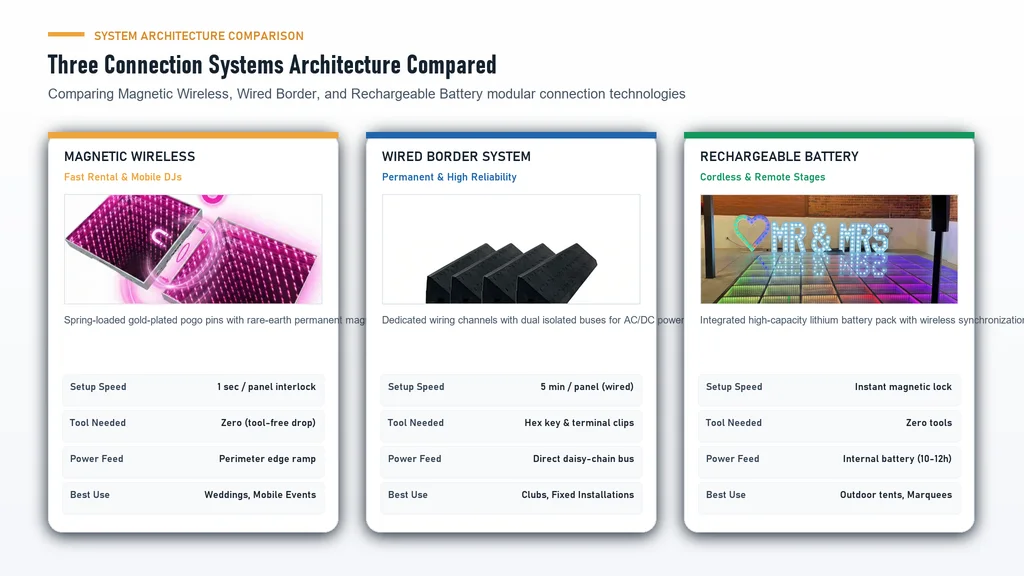
Three connection systems at a glance
Decision factor | Magnetic wireless | Wired | Rechargeable magnetic |
|---|---|---|---|
How panels join | Magnetic edge contact, no cables between panels | Wired border with a two-line design that separates power from control | Magnetic edge contact, with an onboard battery |
Assembly and strike speed | Magnetic joining can reduce inter-panel wiring; schedule complete setup for the selected layout | Slower, because power and control lines are run, dressed and tested | Magnetic speed for the panels, no power cable to the floor |
Tools needed | None | Hand tools, plus electrical work by a qualified person | None for the panels; charging equipment on site |
Power source | Mains feed | Mains feed, permanently wired | Onboard battery, no mains at the floor |
Panel weight | 11kg (50cm) / 14kg (60cm) | 11kg (50cm) / 14kg (60cm) | 11kg (50cm) / 14kg (60cm) standard panel |
Load rating | 600–700 kg per panel (product FAQ; loading conditions not specified) | 600–700 kg per panel (product FAQ; loading conditions not specified) | 600–700 kg per panel (product FAQ; loading conditions not specified) |
Sealing | IP67 | IP67 | IP67 |
Operating temperature | -40°C to 60°C | -40°C to 60°C | -40°C to 60°C |
Borders | Wireless border | Wired border, two-line design | Wireless border |
Control methods | SD, PC/tablet, APP, remote, DMX512, sound | Model- and controller-specific options | Model- and controller-specific options |
Best fit | Temporary events, fast turnaround | Permanent and long-term installations | Sites with no mains power, outdoor events |
Fact: DanceFloorLED covers three connection systems: magnetic wireless (1-second, tool-free), wired (built for long-term and permanent installation) and rechargeable magnetic (battery powered for sites with no mains power).
Magnetic wireless: built for floors that go up and come down
Setup time depends on the floor size, connection option, crew and site tasks. The source describes approximately 30 minutes for two people building a nominal 20 × 20 ft layout; that example is not a guaranteed time for every floor. Include unloading, positioning, power and control connection, testing and breakdown in the crew schedule.
That speed is the argument for this system in rental service. Load-in windows are short and crews are small, and because panels lift out without tools, a single failed panel can be swapped in place rather than taking the floor offline.
Site requirements are modest but real: a level, clean, dry surface, indoor or under cover, and a mains feed to the edge. Within those limits, wireless dance floor panels suit weddings, parties and corporate events, and any booking where the floor arrives and leaves the same day. The 3D abyss LED dance floor and the star LED dance floor are both built on this connection. A magnetic floor on mains power still needs power at the floor, so when a site cannot supply it, the answer is the battery system below rather than a longer cable.
Wired: for floors that stay put
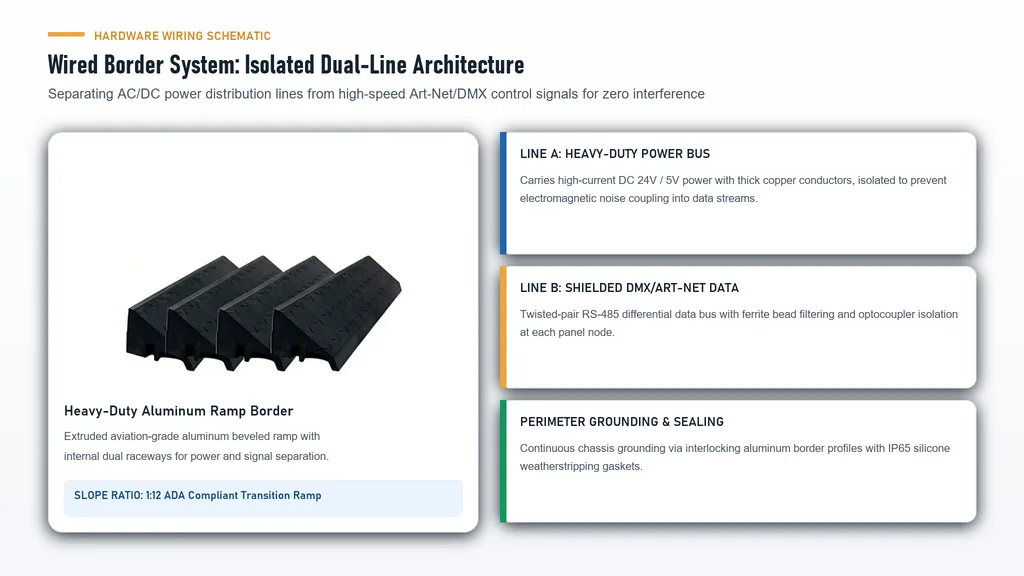
A wired floor is the right answer when the floor is a fixed feature rather than a travelling asset. The DanceFloorLED wired border uses a two-line design that keeps power and control on separate lines, which matters in a permanent installation because the two can be planned, protected and serviced independently.
The advantages compound over time. There is no battery to charge or replace, the supply is continuous, and the floor can be integrated with the building's systems. That suits venues that run the floor nightly rather than seasonally.
The trade-off is flexibility. A wired installation takes longer to build and is not meant to move, so it belongs to nightclubs, bars, permanent venue stages, showrooms and public installations where the floor stays in one place. The power and control lines, the circuit capacity and the earthing are electrical work that a qualified person has to carry out to local regulations. This article explains what to plan, not how to wire.
Rechargeable magnetic: power where there is no power
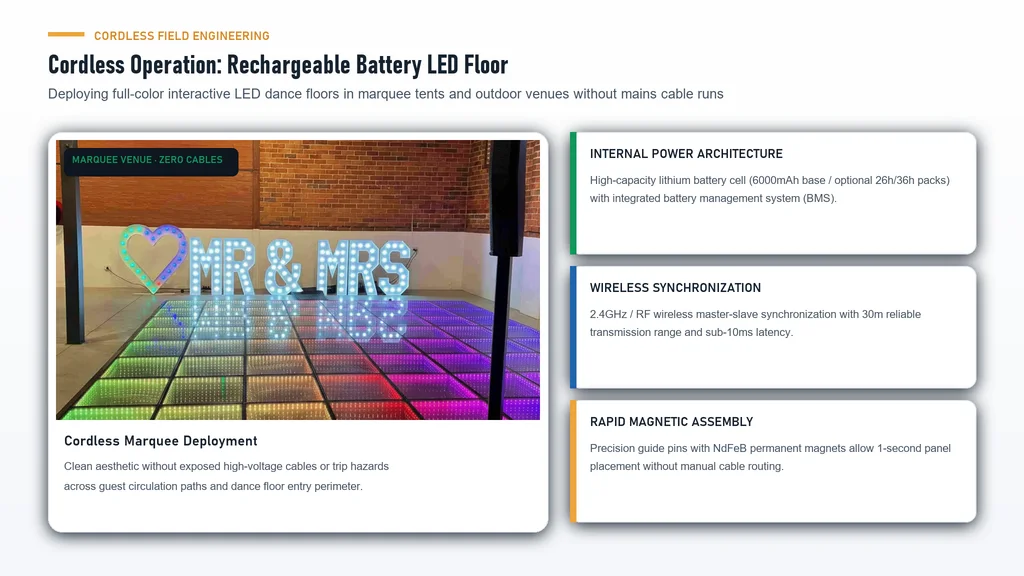
The rechargeable system takes the magnetic connection and removes the cable. Each panel carries its own battery, so the floor needs no mains feed at all. That makes it the answer for marquees, outdoor events, festivals and any site where running power to the floor is impractical or expensive.
Product-detail FAQs describe a 6000 mAh rechargeable option with a 2–3 hour charge time and approximately 10 hours of use. The range overview separately lists 26-hour and 36-hour configurations. Those are not established as the same battery pack, charging arrangement or controller; specify the chosen configuration and its runtime in the quotation.
The connection is identical to the wireless mains version: magnetic, tool-free and fast. A battery floor adds a charging schedule, a spare-battery rotation and a decision about how many packs travel with the fleet, and removes the cable run and any dependency on venue power.
What changes battery runtime
The 10-hour figure is a full-charge runtime under normal conditions. Runtime responds to how hard the floor is worked:
Lower brightness output draws less and lasts longer, while full brightness draws more.
A mostly static, low-white pattern is gentle on the battery, while full-white washes and fast, high-motion effects draw more.
Cold reduces usable battery capacity, so a winter marquee and a warm summer night do not give the same run.
Treat runtime as a range to plan around rather than a guaranteed number, and confirm the configuration against the specific event before committing.
What stays the same across all three systems
The connection system changes the join and the power, not the panel. Every configuration shares the same engineering base.
Shared specification | Value |
|---|---|
Panel sizes | Panel footprint and height are model-specific; Star lists 50 × 50×7 cm /60 × 60×7 cm |
Walking surface | 10mm tempered glass |
LED | SMD 5050 RGB, 16.7 million colors |
Refresh rate | 2000Hz |
Lifespan | Model-specific LED-source data; not a universal operating life or warranty |
Luminous efficacy | 120lm/W |
Rated power | Configured electrical demand to be specified; no confirmed per-panel 20 W basis |
Sealing | IP67 |
Operating temperature | -40°C to 60°C |
Load rating | 600–700 kg per panel (product FAQ; loading conditions not specified) |
Control | SD card, PC and tablet, APP, remote, DMX512, sound |
Packaging | Wheeled flight case or carton box |
Connection choices do not establish a single shared specification for all models. Use the selected product’s surface, dimensions, LED features, environmental limits and electrical schedule. Do not transfer Pixel temperature/refresh data or a merged load figure to the whole range.
IP67 is a defined rating rather than a marketing term: under IEC 60529 it means dust tight with protection against immersion [5]. On a dance floor that covers spilled drinks, cleaning and dust. Tempered glass is a safety glass, and BS EN 12150-1 sets out the fragmentation and physical properties that define it [6]. The wider cost and specification picture across floor types sits in the 2026 LED dance floor buying guide.
Matching the system to the scenario
The three systems overlap far less than the spec sheets suggest once you map them to real bookings.
Scenario | Recommended connection | Why |
|---|---|---|
Wedding in a hotel ballroom, same-day setup | Magnetic wireless | Fast strike, no tools, no loose cabling across a polished floor |
Birthday, anniversary or private party | Magnetic wireless | Quick build and a small crew for a short event |
Corporate event or product launch | Magnetic wireless | Tight load-in and load-out windows with a fixed floor area |
Nightclub or bar with a fixed stage | Wired | Continuous power, no battery routine, floor stays in place |
Permanent venue feature or showroom | Wired | Long-term install with power and control planned separately |
Auto-show display requiring a separate project load assessment | Magnetic wireless, or wired if permanent | A car-show application does not establish vehicle wheel-load or driving approval. Confirm the load distribution, base and complete installation for the intended use rather than deriving vehicle suitability from a per-panel number. |
Music festival or outdoor event with no mains | Rechargeable magnetic | No power at the deck, so onboard batteries carry the floor |
Covered multi-day outdoor event | Rechargeable magnetic | Battery removes the cable run; confirm weather exposure with the supplier |
Public space or urban lighting install | Wired | Permanent, planned infrastructure and service access |
An outdoor request needs a complete site and configuration assessment and must retain the product FAQ exclusion of rain operation. An auto-show request also needs its own load-distribution and base assessment; the per-panel source figure does not approve vehicle rollover.
Control is the same on every connection system
Control options are model- and controller-specific. The Abyss page lists SD-card and PC control with Madrix compatibility, plus its other control options. Pixel lists Windows software, a compatible iOS/Android tablet, DMX512 and remote control. Star lists DMX, remote and controller options, with the undefined source term Voice. Do not assume every connection version supports the same controls or that Madrix runs on the listed tablets.
Control method | Who uses it |
|---|---|
SD card controller | Quick plug-in playback with no laptop or console |
Abyss PC configuration lists Madrix; compatible tablet options depend on the selected model/controller | Content or effect programming before and during the event |
APP wireless | Fast changes from a phone or tablet on the floor |
Remote control (50m range) | Instant effect changes during the event |
DMX512 | Integration with a professional lighting console and the rest of the show |
Sound/Voice options depend on model; Star’s source term Voice is not a defined activation mode | Effects that respond to music automatically |
Control options are model- and controller-specific. The Abyss page lists SD-card and PC control with Madrix compatibility, plus its other control options. Pixel lists Windows software, a compatible iOS/Android tablet, DMX512 and remote control. Star lists DMX, remote and controller options, with the undefined source term Voice. Do not assume every connection version supports the same controls or that Madrix runs on the listed tablets.
Accessories, spares and maintenance
The connection system decides how hard the floor is to keep running, and the accessories follow the same split. Across the range they include controllers, replacement 10mm tempered glass panels, a dedicated power supply with short-circuit and overheat protection, a wireless border with an anti-slip design, a wired border with the two-line power and control layout, and a 50m remote. The border is the part that wears on a working floor, so keeping spares matters.
Connection system | Panel swap | Routine maintenance | Wear item |
|---|---|---|---|
Magnetic wireless | Lift and replace, no tools | Surface cleaning, connector check | Border and connectors |
Wired | Requires isolation and a qualified person | Electrical inspection on a schedule | Wiring and connections |
Rechargeable magnetic | Lift and replace the panel; battery packs are separate | Charging discipline and pack rotation | Battery packs |
Two habits keep a fleet healthy regardless of system: keep spare panels matched to the same LED batch so colours stay consistent when a panel is swapped, and train the crew on the swap before the first booking. The services page covers the accessory supply, quality control and order-tracking side.
What to specify before you order
Ten items, all of them worth writing into the specification rather than agreeing in conversation.
1. Whether the floor is temporary, long-term or permanent, since that single answer rules out one or two of the three systems
2. Whether mains power reaches the floor position, and who provides it
3. The connection system and the border type, wireless or wired
4. If the build is battery powered, the runtime configuration and the charging plan
5. Panel size and weight, and the crew size that weight implies
6. The load requirement, a dance crowd or a vehicle
7. The IP rating, plus an honest account of the site's weather exposure
8. The control method used by the people who will actually run the floor
9. Accessories, the spare ratio and the panel-swap procedure
10. Certifications for the destination market, and confirmation that site electrical and structural work will be handled by qualified persons to local regulations
Use documentation for the selected product: the 3D Abyss page lists CE and RoHS labels with LVD and EMC report labels; the Pixel and Star pages list CE and RoHS. The CNAS wording is a laboratory reference, not a separate product certification. Do not extend one product’s documentation to the whole range.
FAQ
What is the best LED dance floor connection system?
There is no single best system, only the one that fits the job. If the floor is built and struck within a day, magnetic wireless is the default because it connects in 1 second without tools. If the floor stays in one place for months or years, wired is the right answer because it removes the battery routine and runs on continuous power. If the site has no mains power or the floor travels outdoors, rechargeable magnetic is the answer because the panels carry their own power.
What is a magnetic LED dance floor and how do the panels connect?
Setup time depends on the floor size, connection option, crew and site tasks. The source describes approximately 30 minutes for two people building a nominal 20 × 20 ft layout; that example is not a guaranteed time for every floor. Include unloading, positioning, power and control connection, testing and breakdown in the crew schedule.
How long does it take to install a magnetic LED dance floor?
The source gives approximately 30 minutes for a nominal 20 × 20 ft two-person example. It also contains an 8-minute claim without equivalent layout/task detail. Keep those contexts separate and plan the full schedule for the actual floor, crew and site.
What is the difference between magnetic wireless and wired dance floor panels?
The join and the power path differ. Magnetic wireless panels connect on contact with no cables between them, which makes them fast to build and easy to swap, and they suit temporary use. Wired panels use a border with a two-line design that separates power from control, which suits permanent installations where the supply is fixed and the floor does not move.
What is a battery powered LED dance floor used for?
It is used where there is no mains power at the floor, or where running a cable to the floor is impractical. That covers marquees, outdoor festivals, remote party sites and venues that cannot provide a floor feed. Because the panels carry their own battery, the site needs only space for the floor and a plan for charging the packs.
How long does the rechargeable LED dance floor battery last, and what affects it?
Product-detail FAQs describe a 6000 mAh rechargeable option with a 2–3 hour charge time and approximately 10 hours of use. The range overview separately lists 26-hour and 36-hour configurations. Those are not established as the same battery pack, charging arrangement or controller; specify the chosen configuration and its runtime in the quotation.
Can a rechargeable LED dance floor be used outdoors?
Battery power makes a floor workable at a site with no mains, and IP67 covers spills, cleaning and dust. It does not make the floor weatherproof. Rain and standing water are out, and a permanent outdoor installation raises questions of weather resistance, UV exposure, drainage, structural fixing and local electrical and safety rules that a specification sheet cannot answer. Treat outdoor use as a case to be assessed and designed by qualified people before you commit a booking.
Are the control options the same on all three connection systems?
Control options are model- and controller-specific. The Abyss page lists SD-card and PC control with Madrix compatibility, plus its other control options. Pixel lists Windows software, a compatible iOS/Android tablet, DMX512 and remote control. Star lists DMX, remote and controller options, with the undefined source term Voice. Do not assume every connection version supports the same controls or that Madrix runs on the listed tablets.
Which connection system should a rental company buy?
Most rental fleets run on magnetic wireless, because it builds and strikes fast and the panels are simple to swap. A fleet that takes outdoor or no-power bookings should add rechargeable magnetic panels. Wired suits not the travel fleet but clients with a fixed venue, so a rental company usually ends up with magnetic wireless as the standard and the other two as options that match specific bookings in its calendar.
Conclusion
The connection system is a decision about the job, not about the panel. Ask whether the floor moves, and whether power reaches it, and the three options sort themselves out: magnetic wireless for events that come and go, wired for floors that stay, and rechargeable magnetic for sites without power.
Select the connection method, border type and accessory list for the actual floor area and site. The range is not one proven interchangeable panel platform, and no merged 500–700 kg all-model load figure is used.
Send your floor size, whether the site has mains power and your destination market, and you will have a configured quote within 2 hours.
Sources
1. DanceFloorLED. "LED Dance Floor" range page, specification, connection methods, sizing and FAQ content, retrieved 2026-10-30. https://dancefloorled.com/led-dance-floor. Source for panel sizes, panel weight, load rating, IP67, operating temperature, the three connection methods, control methods and sizing.
2. DanceFloorLED. "3D Abyss LED Dance Floor" product page, connection, specification and certification content, retrieved 2026-10-30. https://dancefloorled.com/3d-abyss-led-dance-floor. Source for magnetic connection detail and the model's CE, RoHS, LVD and EMC certification.
3. DanceFloorLED. "Star LED Dance Floor" product page, connection and effect content, retrieved 2026-10-30. https://dancefloorled.com/star-led-dance-floor. Source for the magnetic connection and the preset-effect model's role in the range.
4. DanceFloorLED. Pixel LED Dance Floor product and guide pages, dancefloorled.com. Source of programmable lighting-pattern/control information and product-specific CE/RoHS labels; CNAS wording is a laboratory reference rather than another product certification.
5. BND Test Equipment. "Understanding IEC 60529 Ingress Protection (IP Code) Certification Testing." 2024-08-28. https://www.bndtestequipment.com/industry-news/understanding-iec-60529-ingress-protection-ip-code-certification-testing/. Source for the definition of IP67 as dust tight with protection against immersion.
6. BSI / Intertek Inform. "BS EN 12150-1:2015 Glass in building. Thermally toughened soda lime silicate safety glass." 2015. https://www.intertekinform.com/en-us/standards/bs-en-12150-1-2015-211459_saig_bsi_bsi_500057/. Source for the properties and fragmentation behaviour that define thermally toughened safety glass.
7. MADRIX. "MADRIX 5 Documentation." https://help.madrix.com/. Manufacturer documentation covering fixture configuration and output setup for LED pixel mapping.
led dance floor connection systems