This guide covers RGB, mirror, starlight and programmable pixel lighting dance floors. Video display floors and interactive sensor floors are outside the current product range.
Starting an LED dance floor rental business is not the same as starting a party rental business, and the difference decides whether the first year works. A chair and table operation spreads capital across hundreds of cheap items that rent constantly. A floor operation concentrates it in one or two expensive assets that rent a few times a month, and everything about the business follows from that: the rate you need, the model you buy, the insurance you carry, and how hard you have to work to keep the asset moving.
This guide walks the sequence from capital and model choice through insurance, pricing, first bookings and the first-year cash model, using published rental references and startup guidance from the rental industry.
Fact: DanceFloorLED has manufactured LED dance floors for 13 years, has delivered over 100,000 sets, reports a 98%+ on-time delivery rate, and supports OEM and ODM customization across sizes, effects, patterns and printed branding.
The minimum viable setup is smaller than most people assume, and knowing where the minimum sits keeps the first purchase honest.
Item | Why it is needed | Notes |
|---|---|---|
One LED dance floor | The product | Sizing is covered below; 12x12 ft to 16x16 ft is the common starting range |
Wheeled flight case | Transport and storage | Protects panels and cuts setup time; a carton is cheaper but slower to work from |
Controller and content device | Runs the effects | Tablet, PC, DMX512, remote or WiFi depending on the model |
Transport | Getting it there | A floor plus case fits in a van; size the vehicle to the largest floor you plan to own |
Spare panel | Continuity | One spare turns a failure into a five-minute swap instead of a refund |
Insurance | Venue access | Two coverages, described below |
Storage | Off-season | Dry, secure, ground level where possible |
Two of those items get skipped by new operators and both are expensive mistakes. The flight case is skipped because a carton is cheaper, and the result is slower setup, more damaged edges and a floor that looks used by month six. The spare panel is skipped because nothing has broken yet, and the first failure then happens mid-event with no swap available.
Cost figures in this section are planning examples from the article’s publication date.
Published guidance for party and event rental startups puts all-in launch costs anywhere from $ 5,000 to $ 15,000 depending on the category and the size of the initial fleet [3]. For a single-category LED floor operation, the capital concentrates in one place.
Cost line | Typical range | Notes |
|---|---|---|
LED dance floor, rental grade | $ 6,000-$ 8,000 | The band most rental companies operate in |
Flight case | A four-figure addition on larger floors | Cheap per event over a season, expensive to retrofit |
Transport | Vehicle-dependent | A used van is the usual first solution; do not buy new for a first season |
Insurance | Low monthly range for general liability | Published small-business premiums on a $ 1,000,000/$ 2,000,000 general liability policy sit from $ 47 to $ 79 per month [6] |
Storage | Site-dependent | A dry lock-up is enough to start |
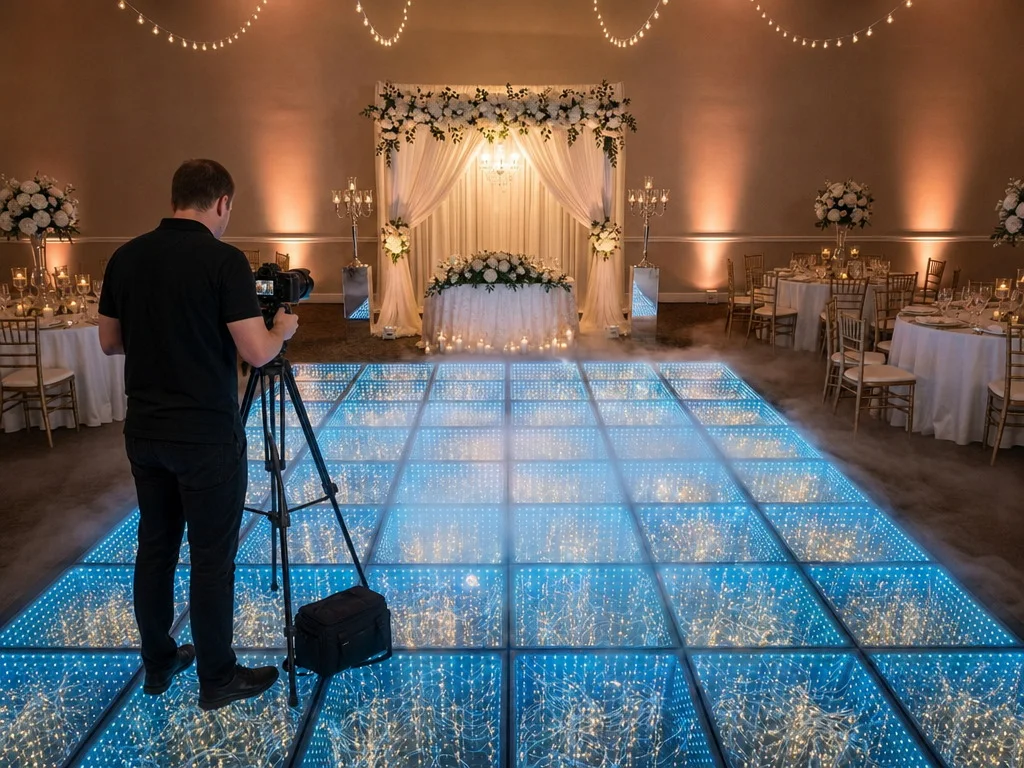
Marketing | Photographer, site listing, printed rate card | The floor cannot be marketed until it has been shot |
Spare panel and consumables | A fraction of the floor cost | Budget it from day one |
Those purchase figures are industry estimates and market listings rather than a manufacturer quotation, and the same applies to every rate in this guide. Two lines are fixed costs that repeat monthly and the rest are one-time, which matters when you model the first year.
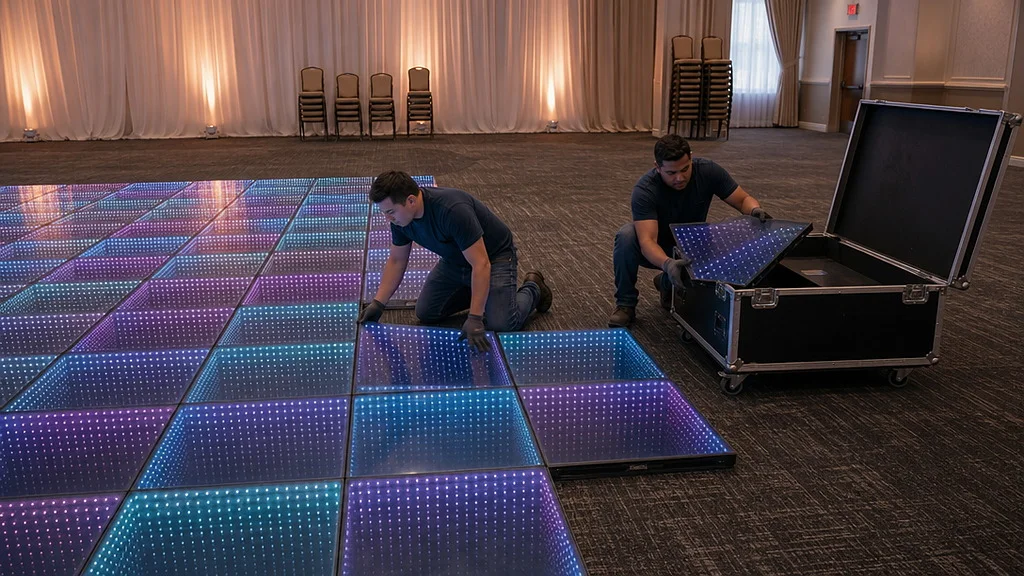
Setup time depends on the floor size, connection option, crew and site tasks. The source describes approximately 30 minutes for two people building a nominal 20 × 20 ft layout; that example is not a guaranteed time for every floor. Include unloading, positioning, power and control connection, testing and breakdown in the crew schedule.
One structure decision is worth making before you buy anything. If you already run a party rental or DJ business, add the floor as a new line rather than as a new company: you already have the insurance, the vehicle, the storage and the client list, and those are the four things a standalone startup has to build from nothing [2][4]. If you are starting from zero, accept that the first season is spent building those four things as much as it is spent renting a floor.
The most expensive mistake in this business is buying the wrong kind of floor, because the error does not show up until you are trying to sell a calendar around it. There are three distinct products and they earn in three different ways.
Type | What it is | Earning mechanism | Buy it when |
|---|---|---|---|
Preset effect floor | A fixed library of looks, such as the 96 effects on the star LED dance floor | Volume: no content work between events, so the floor turns around fast | Your bookings are weddings, parties and school events |
Depth effect floor | A single continuous visual, such as the mirror depth on the 3D abyss floor | Premium: scarcity of the effect supports the top of the rate band | You sell high-end weddings, galas and venue installs |
Content floor | A display surface that runs logos, text and animation, covered in the pixel LED dance floor guide | Rate plus a service line: content can be sold as a deliverable | Corporate and branded work is on your calendar |
The three earning mechanisms are worked through in detail in the ROI guides for the star and 3D abyss models, with the pixel model's specification and rate logic covered in its product page, and the choice between the two most common options is set out in the star versus pixel comparison.
If you cannot decide, ask who is already calling you. A new operator whose phone rings with wedding enquiries from a venue they already work with should buy the preset floor, because it will be out of the case more often and needs no design time. An operator with a corporate contact who has ever asked whether a floor could show a logo should look hard at the content floor, because that single enquiry is the entire case for the higher purchase price.
Size is not a preference. It sets the rate band you can quote, and the published references move in clear steps.
Floor size | Dancers at once | Total guests served | Published rate reference |
|---|---|---|---|
10x10 ft | 10 to 20 | Around 60 | Below the mainstream band |
12x12 ft | 30 to 40 | Around 100 | Around $ 1,200 per event |
15x15 ft | 50 to 60 | Around 150 | Between the 12x12 and 16x16 steps |
16x16 ft | 60 to 80 | Around 180 | Around $ 1,600 per event |
20x20 ft | 100 to 120 | Around 250 | Around $ 2,000 per event |
Sizing follows peak simultaneous dancers rather than attendance, because guests cycle on and off the floor through the night, and the dance floor size guide works through the arithmetic by guest count. A 20x20 ft floor takes 144 panels at the 50 cm panel size.
The commercial rule for a first purchase is that a floor you can fill pays better than a floor you cannot. A 16x16 ft floor that goes out twenty times earns more than a 20x20 ft floor that goes out eight times at a higher rate, and it is cheaper to buy and easier to crew. Start one size below the room you most often work in, then add panels later, because the magnetic panels are modular and a second purchase combines with the first.
This is the part new operators delay and then discover they cannot delay, because it gates access to venues.
Commercial general liability covers third-party injury and property damage, which is what a guest tripping on a cable falls under. An equipment floater covers the equipment itself when it is away from your premises, which is the risk that matters most in a rental business. Rental contract templates in the equipment sector commonly specify general liability of at least $ 1,000,000 and an all-risk equipment floater covering rented or leased equipment, with a loss deductible no higher than $ 1,000 [8]. Treat those as a benchmark to discuss with a broker rather than as your requirement.
Published premiums for small entertainment businesses on a $ 1,000,000/$ 2,000,000 general liability policy sit from $ 47 to $ 79 per month, and the actual figure depends on your region, revenue and coverage [6]. Venues often require limits that meet or exceed their own schedule, and larger venues or events with alcohol commonly sit at higher limits [7].
Three contract terms appear repeatedly in venue and planner agreements: being listed as an additional insured, a waiver of subrogation, and primary and noncontributory wording [10]. None of those are exotic; they are the standard way a venue protects itself, and a broker will recognise them immediately. The practical consequence is that you need a certificate of insurance ready before you confirm a date, not after.
The first is treating a damage waiver as insurance. A loss damage waiver is a waiver in the rental contract, not an insurance product, and rental software platforms handle it as a standard line alongside pre-delivery inspection [9][11]. If you charge one, price it and document it as a waiver, and do not let it stand in for coverage.
The second is assuming a booking app solves the paperwork. Registration, insurance and a written rental agreement are the three documents that let you walk into a venue and be taken seriously [5]. Ask your local authority and the venue directly about permits, power and fire requirements for your area rather than relying on a generic checklist.
Published rental references for LED floors and the displays competing for the same budget look like this.
Reference | Figure | Source type |
|---|---|---|
Small private parties | $ 300-$ 1,500 | Rental operator rate range [12] |
12x12 ft, 16x16 ft, 20x20 ft | $ 1,200 / $ 1,600 / $ 2,000 per event | Published size-based rental rates [13] |
Premium 16x16 ft and above | $ 2,500-$ 5,000, with the top of the market reaching $ 8,000-$ 10,000 | Rental operator and venue guidance [14] |
Per square foot including setup and technician | Around $ 25 | Rental operator pricing [15] |
Day rate | $ 450-$ 700 | Rental business guide [16] |
Three pricing decisions matter more than the headline number.
The first is what the rate includes. Delivery, setup, an operator and collection are four separate costs and clients read a rate card to see which are in it. A quote that includes everything and a quote that includes the floor only are not comparable, and the market's own per-square-foot figures are usually quoted with setup and technician included [15].
The second is how you handle a larger room. Because the rate steps up with size, the 2026 buying guide is useful before you quote, since a client asking about a bigger floor is a client who is already willing to pay the next step.
The third is a floor on your own pricing. Underpricing to win the first five bookings is the most common way a new floor business stalls, because the rate you set with your first clients becomes the rate they expect forever and it becomes the number you measure everything else against.
Four channels refer dance floor work disproportionately often, and all four already sell into the same event.
Venues are the highest-value channel, because a venue that trusts you will suggest you by name for every enquiry that needs a floor. Planners and coordinators are second, and they refer on reliability rather than price. Photographers are third and are the channel new operators most often overlook: a floor photographs well, it improves the photographer's portfolio, and a good image of your floor in a photographer's gallery keeps working for years. DJs are fourth, and they are often the fastest to refer because a lit floor makes their set look better.
Published startup guidance is consistent on what converts behind those channels, and it is unglamorous: equipment photography, a clear rate card, and a booking process that does not require the client to chase you [1][18].
Two pieces of social proof are worth more than a brochure. A short video of the floor being built, because setup speed is the objection every venue has, and a photograph of the floor in a room full of people, because it answers the client's real question of how it will look. DanceFloorLED records order progress by video through testing, packing and dispatch, which gives a new operator material to work from before they have their own event images.
The operational model is where a floor business either stays profitable or quietly eats its own margin.
Confirm the packed dimensions and case count against the delivery vehicle and crew plan. Setup time depends on floor size, handling, the site and power/control checks; do not assign every floor a fixed 8-minute assembly window.
Storage should be dry, secure and ground level if you can get it, because panels and cases that live in a damp lock-up age faster than the panels themselves warrant. Stack in the case, not on the case.
Turnaround is the number that decides how many bookings you can physically take. A floor that goes out Friday and comes back Saturday morning and goes out again Saturday afternoon is a floor earning twice in one weekend, and that pattern is easier to run when the panels connect without tools and the case holds the whole floor in one unit. If you are comparing models on this basis, note that a content floor carries extra turnaround in the form of building and loading content, which is exactly the trade described in the star and pixel comparison.
Crew depth matters more than crew size in the first year. A floor that only one person can operate is a floor that cannot go out on the weekend that person is unavailable, so train the second person before you need them.
Run the arithmetic before you buy, because the purchase is the easy part and the calendar is the hard part.
Scenario | Bookings in year one | Net per event | Gross net income | Against a $ 6,000 floor |
|---|---|---|---|---|
Slow start | 12 | $ 1,000 | $ 12,000 | Pays the floor back twice over |
Steady | 24 | $ 1,100 | $ 26,400 | Pays the floor back and funds a second |
Strong | 36 | $ 1,300 | $ 46,800 | A two-floor fleet is justified |
The net figures follow the same convention used in the ROI guides on this site: gross rental income after labour and transport, before fixed costs such as insurance, storage, vehicle and marketing [12][13][14]. Take those four fixed lines off, and you have the number that actually decides whether the business works.
Two levers change the result more than anything else. The first is bookings, and it is the reason the referral channels above matter more than the equipment specification. The second is the rate band, and it is the reason model choice comes first: the star ROI analysis shows payback arriving through volume, while a content floor earns it through rate and a billable content line.
The utilization metric is worth adopting from day one. Dollar utilization divides annual rental revenue by the cost of the equipment, which is the standard way rental businesses judge whether an asset is working hard enough [17]. A floor bought for $ 6,000 that earns $ 26,400 in a year is running at roughly 4.4 times its cost. Tracking that number from your first season tells you whether to buy a second floor long before your bank balance does.
Six failures account for most of the ones worth avoiding.
Buying too large. A floor that cannot be filled still carries the purchase price, the vehicle requirement and the crew requirement. Start one step below your most common room size.
Skipping the flight case. It looks like a saving and behaves like a maintenance bill, from slower setup and chipped panel edges onwards.
Buying the wrong model. A content floor bought for a wedding calendar carries a pipeline nobody is paying for, and a preset floor bought for a corporate pipeline cannot serve the work that pays the most.
Pricing low to get started. Your first rate becomes your rate, and discounting is much harder to reverse than to set correctly once.
Running without a spare. A single spare panel converts a mid-event failure into a five-minute swap, which is the difference between a refund and a repeat client.
Waiting for inbound enquiries. A new floor business with no venue, planner, photographer or DJ relationships is a business with no distribution, regardless of how good the floor looks.
Budget for the floor plus the things that make it rentable. Published purchase guidance runs from about $ 3,000 for an entry unit to $ 6,000-$ 8,000 for a good rental grade floor, higher for specialist models. Add a wheeled flight case, transport, insurance, marketing and a spare panel budget. Published startup figures in the $ 5,000-$ 15,000 range cover other equipment categories [3], and a single-floor LED operation can sit at the lower end because the capital is concentrated in one asset.
One floor is enough for the first season, because the constraint is demand rather than capacity. Add a second when you are turning work away, when two enquiries land on the same date, or when a client wants a larger floor than yours. Because the panels are modular, a second floor bought at a different size can combine with the first for larger rooms.
Start from your booking mix. If your work is weddings, parties and school events, a preset effect floor carries no content workload and pays back on volume. If corporate and branded events are already on your calendar, a floor that displays logos and text earns a higher rate per event. The star and abyss ROI guides work through the first two cases with published rate references, and the pixel guide covers the content model.
Most venues and corporate clients will not contract with an individual, and insurance generally requires a business entity, so registration usually comes before your first serious booking. The order experienced operators use is entity first, insurance second, client contracts third, because a venue will ask for a certificate of insurance before confirming a date [5].
Two coverages come up repeatedly: commercial general liability, and an all-risk equipment floater covering rented or leased equipment. Rental contract templates commonly specify general liability of at least $ 1,000,000 with a loss deductible no higher than $ 1,000 [8]. Published premiums for small entertainment businesses on a $ 1,000,000/$ 2,000,000 policy sit from $ 47 to $ 79 per month [6], and venues often require limits that meet or exceed their own [7].
Published references put a 12x12 ft floor around $ 1,200, a 16x16 ft around $ 1,600 and a 20x20 ft around $ 2,000 per event [13], with net income after labour and transport commonly modelled at $ 1,000-$ 1,300 per booking. Multiply by the events you can realistically sell, then subtract insurance, storage, vehicle and marketing. Treat these as industry estimates and market listings rather than a quotation.
Venues, planners, photographers and DJs refer dance floor work most often, because they already sell into the same event. Photographers matter more than new operators expect, because a floor photographs well and becomes part of their portfolio. Published startup guidance is consistent that equipment photography and a clear rate card convert enquiries [1][18], so the floor has to be shot before it can be marketed.
The original product page lists an IP67 panel rating. Connections and the power supply need their own specified protection; the panel rating does not establish the weather suitability of the whole installation. The product FAQ excludes outdoor use in rain, and battery power does not change that restriction.
Every number in this guide points at the same conclusion: the floor you buy should match the bookings you can already see. A preset effect floor for a wedding calendar pays back on volume, a depth effect floor sells the top of the rate band, and a content floor earns its price through both a higher rate and a billable content line. Buying before you know which of those three describes your market is the most expensive way to learn the difference.
DanceFloorLED builds all three for rental fleets and venues, with magnetic no-tool assembly, 10mm tempered glass rated to 600-700kg per panel, IP67 sealing, battery options for venues without accessible power, and flight case or carton packaging. Fleets starting out can compare the star, 3D abyss and pixel models directly, or set a fleet plan against your own calendar with the solutions team. Custom sizes, effects and printed branding are available through the OEM and ODM program, and the contact page reaches the factory directly.
1. Rentrax. "How to start a Party & Event Rental Business in 2026." rentrax.com, November 2025. https://rentrax.com/blog/how-to-start-a-party-event-rental-business-in-2026/ . Nine-step startup framework with cost tables and profit margin guidance.
2. MCS Rental Software. "How to Start an Event Equipment Rental Business." mcsrentalsoftware.com. https://www.mcsrentalsoftware.com/us/resources/blog/how-to-start-an-event-equipment-rental-business/ . Profitability structure for event equipment rental.
3. HeroKiddo. "Steps to Launch Your Event Rental Business." herokiddo.com. https://herokiddo.com/blogs/news/steps-to-launch-your-event-rental-business-and-dominate-the-inflatable-event-market . Published startup cost range of $ 5,000-$ 15,000 covering equipment, insurance, marketing and storage in the inflatable category.
4. HoneyBook. "How To Start An Event Space Business: The Practical Guide." honeybook.com, June 2026. https://www.honeybook.com/blog/how-to-start-an-event-space-business . Business planning, budgeting and compliance framework.
5. Twice Commerce. "Start a Party Rental Business: Step-by-Step Guide." twicecommerce.com, May 2025. https://www.twicecommerce.com/blog/how-to-start-a-party-rental-business . Legal setup, licensing and insurance as prerequisites to the first booking.
6. General Liability Insure. "Theater Insurance: Compare Quotes & Costs (2026)." generalliabilityinsure.com. https://generalliabilityinsure.com/small-business/theater-insurance.html . A standard $ 1,000,000/$ 2,000,000 general liability policy for small entertainment businesses priced from $ 47 to $ 79 per month.
7. Kingsixteen. "Pop Up Shop Insurance: Quick Checklist for Brand Teams." kingsixteen.com. https://kingsixteen.com/blog/pop-up-shop-insurance . Commercial general liability limits must meet or exceed venue requirements, with higher limits common for large venues and alcohol service.
8. GG Heavy Equipment. "Credit Application and Customer Agreement: Insurance Requirements." ggheavyequipment.com, 2026. https://www.ggheavyequipment.com/pdfs/GGCreditAppInsuranceRequirementsV2026.pdf . Rental contract template requiring general liability of at least $ 1,000,000, all-risk equipment floater coverage for rented or leased equipment, and a loss deductible not exceeding $ 1,000.
9. Wynne Systems. "Business Management: 12 Ways to Realize Rental Revenues." wynnesystems.com. https://wynnesystems.com/business-management-12-ways-to-realize-rental-revenues/ . Loss damage waiver treated as a waiver that mitigates liability, explicitly not insurance.
10. Allied Insurance Group. "Mistakes Catering Businesses Make with Insurance." alliedinsgroup.net. https://alliedinsgroup.net/miscatering-businesses-make-with-insurance/ . Common venue contract requirements: additional insured status, waiver of subrogation, and primary and noncontributory wording.
11. For Construction Pros. "The Gaps in Equipment Rental Insurance." forconstructionpros.com, January 2026. https://www.forconstructionpros.com/rental/rental-business/article/22957802/assurant-inc-the-gaps-in-equipment-rental-insurance . Loss damage waiver and pre-delivery inspection handled as standard lines in rental platforms.
12. Event Brothers. "Dance Floor Cost: Prices by Size & Money-Saving Tips." eventbrothersco.com. https://eventbrothersco.com/dance-floor-cost/ . Rental rate range of $ 300-$ 1,500.
13. Torkay Events. "LED Light Up Dance Floor Rental." torkayevents.com. https://www.torkayevents.com/items/led_light_up_dance_floor_item/ . Size-based rental rates: 12x12 ft $ 1,200, 16x16 ft $ 1,600, 20x20 ft $ 2,000.
14. Beyond Tent. "Should Your Venue or Party Rental Business Invest in an LED Dance Floor?" beyondtent.com. https://beyondtent.com/blogs/beyond-tent-blog/should-your-venue-or-party-rental-business-invest-in-an-led-dance-floor . 16x16 ft rentals at $ 2,500-$ 5,000, up to $ 8,000-$ 10,000.
15. CEG Interactive. "LED Dance Floors." ceginteractive.com. https://ceginteractive.com/led-dance-floors/ . Per-square-foot pricing around $ 25 including setup and technician.
16. LendControl. "How to Start an Event Rental Business in 2026." lendcontrol.com. https://lendcontrol.com/blog/how-to-start-event-rental-business/ . Day-rate range of $ 450-$ 700.
17. Ajelix. "10 Equipment Rental KPIs For Rental Business." ajelix.com. https://ajelix.com/bi/equipment-rental-kpis/ . Dollar utilization defined as annual rental revenue divided by total acquisition cost.
18. ezo.io. "How to Start a Party Rental Business in 7 Steps." ezo.io. https://ezo.io/ezrentout/blog/party-rental-business/ . Startup sequence covering equipment purchase, equipment photography, market-based pricing and legal setup.
19. DanceFloorLED product detail, range and services pages, dancefloorled.com. Source of model-specific facts. Panel ratings, electrical demand, battery options, control compatibility and documentation must retain their own product/configuration scope; these pages are not a unified per-panel 20 W, all-range certification or fixed setup-time specification.
Note: Rental rates, purchase costs, premium ranges and earnings examples in this article are industry estimates and market listings gathered from the sources above, not DanceFloorLED's official pricing. Manufacturer specifications are per DanceFloorLED's product pages. Insurance figures are published general ranges for small businesses and are not a quotation; your own premium depends on region, revenue and coverage. Labour is expressed per event or in hours so that operators can apply their own rates.