This guide covers RGB, mirror, starlight and programmable pixel lighting dance floors. Video display floors and interactive sensor floors are outside the current product range.
A custom LED dance floor is where most rental companies either build a fleet that outlasts the competition or buy a headache they spend three seasons explaining to clients. The difference is rarely the effect. It is whether the customization you asked for was specified, drawn, sampled and inspected before production started, or whether it was agreed in a chat message and discovered on arrival. This guide covers the whole path: what can actually be changed, what a manufacturer should refuse to change, how the order runs from brief to delivery, and which checkpoints protect you when the floor is not a standard rectangle. DanceFloorLED builds custom LED dance floor systems for rental fleets and venues out of its own factory, and this is the process it runs.
Fact: DanceFloorLED is an own-factory LED dance floor manufacturer with 13 years of production experience, over 100,000 sets delivered, and a 98%+ on-time delivery rate.
Most buyers assume every number in a spec sheet is negotiable. It is not, and the fastest way to judge a supplier is to watch which numbers they offer to move.
Some specifications exist to sell the floor, and some exist to keep people standing on it. Glass thickness, waterproof rating and load rating belong to the second group. A supplier who offers to thin the glass or quietly drop the IP rating to reach a target price has told you how the rest of the order will be handled.
A custom LED dance floor also produces a document trail that a stock floor never needs: a signed layout drawing, a named effect list, an artwork proof for anything carrying your logo, and a QC report per batch. If a supplier cannot describe that trail before you ask, they are assembling floors rather than building them.
Size and shape, panel size, surface finish, effect content, hardware branding, packaging type, battery runtime, control interfaces and the voltage configuration for your market are all open. These choices change how the floor performs on a job, which is why they are worth specifying carefully rather than accepting a default.
Specify the walking surface, panel protection and load conditions for the selected model. The current product pages list 10 mm tempered glass and IP67 panel ratings, but those statements do not establish outdoor rain operation or one universal load-test condition.
Item | Customizable | Typical range | Why it matters |
|---|---|---|---|
Floor size and shape | Yes | Standard sizes from 10x10 ft to 24x24 ft, plus irregular layouts | The room decides the size, not the catalog |
Panel size | Yes | Panel footprint and height are model-specific; Star lists 50 × 50×7 cm /60 × 60×7 cm | 60 cm covers floor area faster, 50 cm fits tighter rooms |
Surface finish | Yes | Full mirror, or mirror mixed with frosted panels | Changes the visual read, not the safety |
Effect content | Yes | Presets on star and abyss models; uploaded text, logos and animation on the pixel model | Determines which model suits your booking mix |
Hardware branding | Yes | Flight case, controller, edge trim, manual, carton | Your brand travels with the fleet |
Packaging | Yes | Wheeled flight case or carton | Rental fleets need the case, installations do not |
Battery runtime | Yes | Product-detail FAQs describe a 6000 mAh rechargeable option with a 2–3 hour charge time and approximately 10 hours of use. The range overview separately lists 26-hour and 36-hour configurations. Those are not established as the same battery pack, charging arrangement or controller; specify the chosen configuration and its runtime in the quotation. | Decides whether multi-day outdoor work is possible |
Voltage and plug | Yes | 110V or 220V configuration matched to the destination | The wrong configuration fails at the venue, not the factory |
Glass thickness | No | 10mm tempered, fixed | It is the structural and safety baseline |
Waterproof rating | No | IP67 panel rating; complete-system protection and the no-rain restriction remain separate | It decides where the floor is allowed to go |
Load rating | No | 600–700 kg per panel (product FAQ; loading conditions not specified) | Guest safety, not a marketing figure |
The product pages list 10 mm tempered glass and magnetic connection options. ABS housing is explicitly listed on the Frosted product page. Keep housing, load conditions and connection details attached to the selected model rather than combining them into a single all-range specification.
Sizing a dance floor is not about the guest count. It is about peak simultaneous dancers, because most guests cycle on and off the floor across the evening. DanceFloorLED's own sizing table, published on its LED dance floor range page, pairs each size with both a dancer figure and a total guest figure, and the two are far apart on purpose.
Both available panel sizes are modular, so the layout reduces to a grid. Calculated from the panel dimensions, a 60x60 cm panel covers roughly 3.9 sq ft and a 50x50 cm panel roughly 2.7 sq ft, which means panel count follows directly from the floor area you need. At the 50 cm size, a 20x20 ft floor works out to 144 panels, the figure DanceFloorLED publishes for that configuration on its size and style guide.
The panel count drives three things buyers usually discover too late: the per-job install time, the number of flight cases you have to truck, and the spare-panel budget you should hold for a fleet that works every weekend.
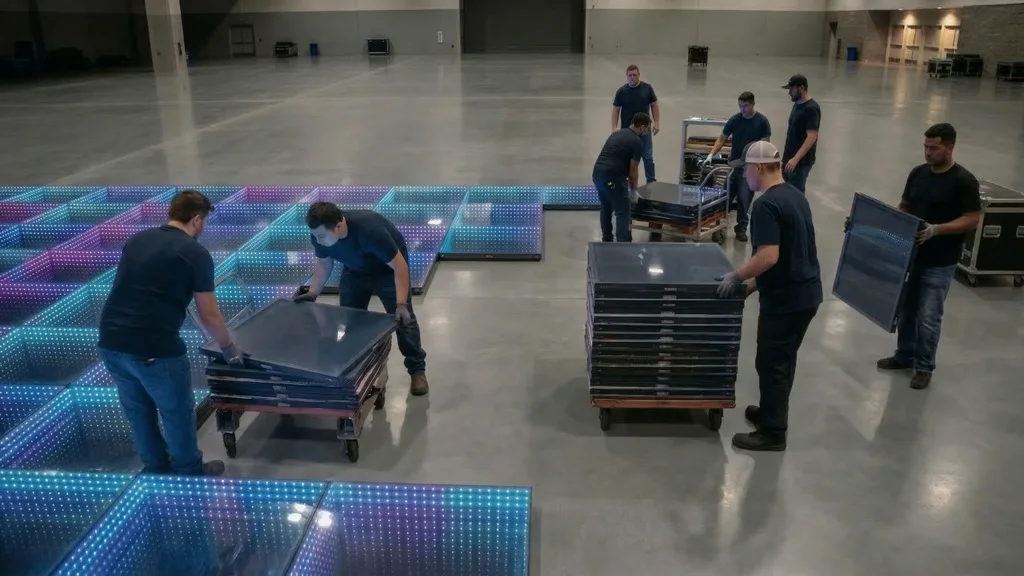
Panels have to sit on the grid, so a custom shape is an arrangement rather than a mold. Runways, L-shapes, stage extensions and broken outlines are all normal requests, and they work as long as the perimeter trim can follow a straight run along each edge.
Two constraints are worth checking before you commit to a shape. Keep the power box reachable without lifting the middle of the floor, and leave access at door widths for the cases, because a floor that cannot be rolled into the room is a floor that cannot be installed.
Floor size | Dancers at once | Total guests served |
|---|---|---|
10x10 ft | 10-20 | 60 |
12x12 ft | 30-40 | 100 |
15x15 ft | 50-60 | 150 |
16x16 ft | 60-80 | 180 |
18x18 ft | 70-80 | 200 |
20x20 ft | 100-120 | 250 |
24x24 ft | 120+ | 400 |
The gulf between the two middle columns is the single most useful number in this article. A client booking a 100-guest wedding needs a 12x12 ft floor, not a floor built for 100 people standing on it at once.
Content is where custom orders go wrong, because buyers assume "custom" means "your logo on the floor" regardless of model. It does not. Two of DanceFloorLED's four platforms cannot display a logo at all, and no amount of customization changes that.
The star model layers a starry pattern over a 3D infinite mirror base and ships with 96 built-in dynamic effects. The 3D abyss model runs a single continuous depth effect. Both are effect floors: you can choose and arrange what is already in the library, but neither renders uploaded artwork. The star LED dance floor guide and the 3D abyss LED dance floor guide break down the effect libraries on each.
A fourth configuration combines mirror and frosted panels in one floor, mixing the abyss depth effect with a frosted surface that reads as a rainbow spread. It is the option for buyers whose clients want something the venue has not seen, and it is worth comparing against the model comparison guide before you commit a season's capital to it.
Model | Effect type | Custom logo or text | Best booking type | Customization headroom |
|---|---|---|---|---|
Star | Starry pattern over 3D infinite mirror, 96 presets | No | Weddings, parties, DJ sets, school events | Effect selection and arrangement |
3D Abyss | Single continuous depth effect | No | Premium weddings, galas, nightclubs | Effect selection, panel finish |
Abyss + Frosted | Mirror and frosted panels mixed, rainbow read | No | Venues and clients wanting a novel look | Panel mix ratio, effect selection |
Private label work on a dance floor is mostly about the parts that travel. The walking surface is the worst place for a logo, because tempered glass takes foot traffic and heel scuffs, and a graphic printed there wears into a smudge within a season.
The parts worth branding are the ones a client sees before and after the event. That means the flight case exterior, the controller housing, the edge trim, the quick-start card, and the carton on installations that ship in cardboard rather than a wheeled case. DanceFloorLED produces all of them to your artwork.
Two practical notes. Ask for an artwork proof before production, because a case print is a one-time setup and reprints cost a new run. And print your own contact details on the quick-start card, since that card is often the only piece of documentation a venue technician reads when the floor goes down at a new site.
A custom floor is built for one destination market, and the electrical configuration has to be locked before production rather than corrected on arrival. DanceFloorLED matches the driver, power supply and plug to the destination, and the configuration is different for a fleet going to North America than for one going to the EU.
Use the electrical schedule for the selected panel, controller and power-supply configuration to plan demand. The 3D Abyss FAQ lists a 20 W rated-power figure without stating whether it is per panel or per system, so it cannot be multiplied by the panel count. Confirm the configured maximum and average demand before sizing distribution.
Three directives do the work for a floor sold into Europe. The Low Voltage Directive (2014/35/EU) covers electrical safety on equipment in its voltage range, and an EU notified body such as TÜV SÜD describes the compliance route and the testing it involves [5]. The EMC Directive (2014/30/EU) governs electromagnetic compatibility, and the RoHS Directive (2011/65/EU) restricts hazardous substances in the electronics. European Commission market surveillance work on LED lighting equipment treats the EMC Directive as the essential requirement under test for this product family [4], and compliance consultancies map the RoHS and related directives to electronic products the same way [6].
What you should receive is the CE marking plus a Declaration of Conformity naming the directives the product was assessed against. A certificate scan with no declaration behind it does not tell you which directive was tested.
The United States runs on a different stack. UL 1598 is the luminaire safety standard and UL 8750 covers LED equipment for use in lighting products, and UL itself treats them as separate standards with separate scopes [7]. Alongside them sits Part 15 of the FCC rules, which sets the technical requirements for radio frequency devices that operate without an individual licence and therefore applies to the electronics inside a lit floor [8].
For the walking surface, the standard to ask about is EN 12150-1, which defines the tolerances, fragmentation behaviour and physical characteristics of thermally toughened soda lime silicate safety glass [1]. Where a project is risk sensitive, ask whether the glass was heat soak tested to EN 14179-1, the process that reduces the chance of spontaneous breakage from nickel sulphide inclusions [2]. On sealing, ask for the IP rating rather than the word waterproof: IEC 60529 defines the two-digit code, and IP67 means dust tight with protection against immersion, which is a specific claim with a specific test behind it [3].
DanceFloorLED supports OEM/ODM work across size, effects, patterns and printed branding, and the original site states quotation support within 2 hours. Match product documentation to the selected model: CE/RoHS labels and applicable report labels are not a catalogue-wide CNAS product certification.
A custom order has more stages than a stock purchase, and every extra stage is a place where a detail can drift. Here is the sequence DanceFloorLED runs, and what you should expect to receive and approve at each point. Buyers usually find that the solutions overview matches this shape, because the workflow is driven by the product rather than by the sales team.
You send room dimensions, guest numbers, the effect you want, the destination market and any branding requirement. DanceFloorLED quotes within 2 hours. The output at this stage is a written specification, and it is the document every later stage is checked against.
The supplier returns a panel layout on the grid, a panel count, a named effect list, and a packaging proposal. For an irregular shape this is where the perimeter trim and power box position get resolved, and it is the first point where a bad idea is cheap to fix.
You sign the drawing and the effect list. Nothing should move into production before this signature exists. A supplier willing to start cutting panels on a verbal agreement has removed your only cheap correction point.
Before a bulk run, see the actual thing: a sample set or the first panels off the line, with the LED chip and glass you ordered, and a proof of any branding. Testing a sample under your own event lighting reveals more than a showroom demo, because the effect is what your client is buying.
Once the specification is signed and the sample approved, the floor goes into production. Published sourcing guidance for this category puts mass production at roughly 15 to 30 days from a confirmed specification, with samples shipping in about 3 to 7 days [14].
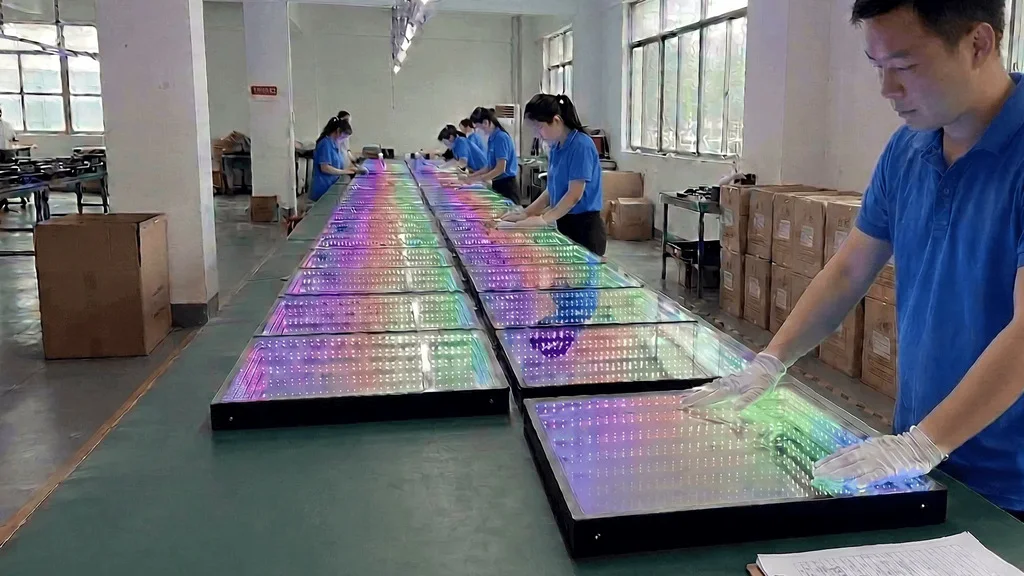
DanceFloorLED runs a full-chain QC sequence: raw material inspection, semi-finished testing, a finished-product aging test, and pre-shipment sampling, all handled by a dedicated QC team in a separate inspection area. The output you should ask for is a QC report per batch rather than a promise.
Floors ship in a wheeled flight case for rental fleets or a carton for fixed installations. DanceFloorLED records the process on video, from product testing through packing to shipment, which means you can watch your order being packed rather than waiting to see what arrives. See the services page for how order tracking runs through the build.
Stage | What you receive | What you sign off | Typical duration |
|---|---|---|---|
1. Enquiry | Written specification and price | Specification | Within 2 hours for the quote |
2. Solution | Layout drawing, panel count, effect list, packaging proposal | Not yet, this is review | Days |
3. Design sign-off | Final drawing and effect list | Drawing and effect list | Same week as stage 2 |
4. Sample or first article | Sample set or first production panels, artwork proof | Sample approval | 3 to 7 days for a sample [14] |
5. Production | Build progress updates | Nothing further | 15 to 30 days [14] |
6. QC and testing | QC report for the batch | Nothing, this is verification | Within the production window |
7. Packing and shipment | Packing video, packing list, shipping documents | Packing list and case count | Per shipping schedule |
Custom work does not raise a price evenly. It raises specific line items, and knowing which ones lets you trade features against budget instead of accepting a lump sum.
Panel size sets material consumption, so a larger panel reduces panel count but changes the trim and case count. Glass and LED chip grade set the durability and the visual output. Battery options, control hardware and packaging add fixed cost per system, and a wheeled flight case costs more than a carton. Branding adds a one-time setup. Then volume and freight sit on top.
Factories in this category commonly accept a single sample while applying a separate commercial minimum to bulk runs, so ask for both terms in writing rather than extrapolating from a sample listing [14]. DanceFloorLED confirms the bulk figure against your actual configuration, because panel count, battery option and packaging all shift the threshold.
The standard structure on a first order with a Chinese manufacturer is 30% at order confirmation and 70% before shipment or against the bill of lading, a split that protects the factory's material cost while keeping your balance tied to finished goods [11]. A request for materially more than 30% upfront from a supplier you have not ordered from before is worth questioning.
Dance floors are heavy and bulky, so bulk orders move by sea while samples can fly. Build transit time into your season planning, and check the case count before you book a vehicle, because the packing list is what determines whether the fleet fits.
The real risk in a custom order is not a bad product. It is a good product that is not the one you specified, arriving after the season has started. First-article approval is the only cheap defence, and it works because it moves the discovery to a point where a correction costs a day rather than a container.
Before production, you want a signed layout drawing with the panel count, a named effect list with the number of effects, a physical sample showing the actual LED chip and glass, a branding artwork proof, and written confirmation of voltage, frequency and plug type. If any of those five items is missing, the order is running on assumption, and assumption is what custom orders get wrong.
DanceFloorLED runs four checkpoints in sequence: raw material inspection on arrival, semi-finished testing during assembly, an aging test on the finished product, and pre-shipment sampling before the cases close. The work happens in a dedicated inspection area with a QC team assigned to it, so component lot testing does not compete with production throughput.
Ask for the report rather than the claim. A batch QC report with the tested items named is a document you can put next to the packing list, and it is the difference between a supplier who tested and a supplier who says they did.
Six patterns show up in custom orders that end badly, and all six are visible before money moves.
The drawing is never signed. A supplier happy to start production on a chat message has removed your correction window. Insist on a signed drawing and effect list.
There is no first-article step. A bulk run with nothing to approve first converts every spec error into a full-batch loss. Sample terms are cheap next to that.
The certification cannot be verified at the source. Ask which body issued the certificate and confirm it with that body. Confirm the business licence against China's national enterprise credit publicity system at gsxt.gov.cn, and check that the registered business scope covers manufacturing rather than trading [9][10], because a licence is the one document a reseller cannot fake convincingly.
The price is materially below every other quote. Custom work adds cost. A quote that undercuts the field by a wide margin is usually recovering it somewhere else, most often in glass, sealing or QC.
Packaging costs appear late. Ask for the flight case and carton options in the first quote, including case count, so freight and vehicle planning are based on facts.
There is no build record. If you cannot see photos or video of your own order in production and packing, you are buying on faith. DanceFloorLED records the process from testing through packing to shipment for exactly this reason.
Size and shape, panel size, surface finish, effect content, hardware branding, packaging, battery runtime and the voltage configuration are all open to change. Glass thickness, waterproof rating and load rating are not, because those three set the safety floor the floor stands on. A supplier that offers to thin the glass or drop the IP rating to hit a price is telling you how the rest of the order will go.
Factories in this category commonly accept a single sample and apply a separate commercial minimum to bulk runs, so ask for both numbers in writing rather than assuming the sample terms carry over [14]. DanceFloorLED quotes within 2 hours and will confirm the bulk figure against your configuration, since panel size, battery option and packaging all move the threshold.
Sample sets typically ship in 3 to 7 days, and mass production runs 15 to 30 days from a confirmed specification [14]. Custom branding, unusual panel counts and flight-case printing sit at the longer end because they add a setup step. Build the window into your season calendar and add sea transit time on top, since a floor is too heavy and bulky to fly economically.
Yes. Panels are modular at 50x50 cm or 60x60 cm, so a floor can run as a runway, an L, a stage extension or a broken outline as long as the panels stay on the grid. Irregular layouts cost more in perimeter trim and take longer to draw, so send a sketch with room dimensions and door widths before you ask for a quote.
Custom work adds cost in specific places rather than across the board: artwork setup for branding, non-standard panel counts, longer perimeter trim runs, and packaging if you move from carton to a wheeled flight case. Size, panel finish and battery option move the price more than any decorative detail. Ask for a line-by-line breakdown so you can see which choice is driving the number.
Yes, and it has to be specified before production, not corrected on arrival. DanceFloorLED matches the driver, power supply and plug to the destination market and ships the compliance file that goes with it: the LVD, EMC and RoHS documents for Europe, and UL 1598, UL 8750 plus FCC Part 15 evidence for the United States. Confirm the voltage, frequency and plug type in the written specification.
Yes, provided the original order matched the LED batch and the connector generation used on the rest of the floor. Order the same panel size, LED type and connector, and keep a copy of the original specification sheet. Mixing panel sizes or connector generations in one floor causes visible seams and alignment problems, which is exactly the kind of detail worth writing into the first purchase order.
Custom LED dance floor projects do not fail at the effect. They fail at the paperwork: an unsigned drawing, a missing sample, a voltage chosen in the last week, a case count nobody checked. Every one of those is preventable, and none of them cost much to prevent at the point of order.
Start with the model that fits your bookings, then define the custom work. The3D Abyss and frosted/mirror ranges provide depth and colour options, Star combines mirror depth with star patterns, and Pixel provides programmable RGB patterns, text and logos within the selected layout and controller. DanceFloorLED builds the range in its own factory, with 13 years of production and more than 100,000 sets shipped as stated on the original site.
Send your room dimensions, guest numbers and destination market, and you will have a configured quote within 2 hours.
1. BSI / Intertek Inform. "BS EN 12150-1:2015 Glass in building. Thermally toughened soda lime silicate safety glass." 2015. https://www.intertekinform.com/en-us/standards/bs-en-12150-1-2015-211459_saig_bsi_bsi_500057/. Tolerances, fragmentation and physical characteristics of thermally toughened safety glass.
2. Slovak Standards Database (normy.normoff.gov.sk). "EN 14179-1 Glass in building. Heat soaked thermally toughened soda lime silicate safety glass." 2016. https://normy.normoff.gov.sk/norma/123756/nahlad/. The heat soak process and its effect on breakage behaviour.
3. BND Test Equipment. "Understanding IEC 60529 Ingress Protection (IP Code) Certification Testing." 2024-08-28. https://www.bndtestequipment.com/industry-news/understanding-iec-60529-ingress-protection-ip-code-certification-testing/. Definition of IP67 as dust tight with protection against immersion.
4. European Commission. "LED lighting equipment market surveillance report." https://ec.europa.eu/docsroom/documents/45507/attachments/1/translations/en/renditions/pdf. EMC Directive 2014/30/EU treated as the essential requirement under test, with RoHS 2011/65/EU in scope.
5. TÜV SÜD. "Low Voltage Directive Testing Services (2014/35/EU)." https://www.tuvsud.com/en-us/services/product-certification/ce-low-voltage-directive. Notified body description of the LVD compliance route and testing.
6. EUVerify. "Which EU Directive Applies to Your Electronic Product?" 2026-04-20. https://euverify.com/resource/eu-directive-for-your-electronic-product/. Mapping of EMC, RoHS, WEEE and battery regulation to electronic products.
7. UL (code-authorities.ul.com). "LED Signs and Luminaires." https://code-authorities.ul.com/wp-content/uploads/2014/07/ul_LEDSignsLuminaires.pdf. Scope of UL 1598 (luminaires) and UL 8750 (LED equipment) as separate standards.
8. Federal Communications Commission. "Part 15 of the FCC Rules: Small Entity Compliance Guide." https://docs.fcc.gov/public/attachments/DA-16-479A1.pdf. Technical requirements for radio frequency devices operated without an individual licence.
9. China Legal Experts. "Factory Verification in China." https://www.chinalegalexperts.com/news/factory-verification-in-china. Use of the National Enterprise Credit Information Publicity System (gsxt.gov.cn) to confirm legal registration and licence details.
10. Sinospect. "Manufacturer or trading company? Verify a Chinese supplier." 2026-06-16. https://sinospect.com/resources/china-supplier-qualification/manufacturer-vs-trading-company. Checking registered business scope and factory address to tell a manufacturer from a reseller.
11. Harris Sliwoski (China Law Blog). "China Manufacturing Payment Terms." https://harris-sliwoski.com/chinalawblog/china-manufacturing-payment-terms/. The 30% deposit and 70% before shipment structure as standard practice.
12. Global Sources. Wholesale LED dance floor stage display listing, tiered pricing per square meter. https://www.globalsources.com/LED-dance/Led-dance-floors-stage-displays-night-club-screen-1172966684p.htm. Public listing used only as an order-of-magnitude reference for display-grade floor tile.
14. Published sourcing guidance for LED dance floors (spec, OEM and factory verification practices for this product category). https://www.xtoolsupplier.com/blogs/news-1/led-dance-floor-sourcing-guide-specs-oem-and-how-to-vet-a-china-factory. Category practice on sample terms, bulk minimums and production lead times. Used for operational detail only.