Buying an LED Dance Floor Direct from the Manufacturer: What Distributors Should Verify
Buying an LED dance floor direct from the manufacturer is a verification exercise before it is a price negotiation. A distributor who wires a deposit to a seller with no production line pays a reseller's margin and inherits a supply chain risk. A distributor who buys from the line gets engineering support, batch consistency and a warranty relationship that survives the second order. This guide is for distributors, wholesalers and rental-company buyers who have to confirm who actually builds the floor. It covers how to separate a factory from a trading company, what a direct quotation should contain, how samples and first articles are approved, how production is tracked, and how certification is confirmed per model.
Fact: DanceFloorLED is a factory-direct LED dance floor manufacturer with 13 years of manufacturing experience, more than 100,000 sets delivered worldwide, a 98%+ on-time delivery rate and a quotation turnaround within 2 hours.
What "direct from the manufacturer" should mean
The phrase has a specific operational meaning, and it is worth fixing that meaning before you compare quotes. A factory-direct supplier owns the tooling and the assembly line, runs its own quality control, and can show the process that turns components into a finished panel. A trading company owns none of that: it buys finished goods and resells them, which is fine when the price reflects the service and dangerous when the price is presented as a factory cost.
Three things depend on the difference. Engineering support: only the builder can answer a structural or electrical question, or change a specification for your market. Batch consistency: a second shipment needs the same LED bin, glass, firmware and connector tolerance as the first, which is a production capability, not a sales promise. The warranty relationship: when something fails in the field, the useful conversation is with the party that can diagnose and replace.
DanceFloorLED is the manufacturer in this relationship. It has spent 13 years building LED dance floors, delivered more than 100,000 sets, and runs its own production plant with a complete line. That is the baseline to demand from any factory-direct supplier, and the claim you are entitled to verify. The fuller picture is on the about DanceFloorLED page.
Separating a factory from a trading company
No single document proves a seller owns a production line, but a short set of questions does, because the answers are hard to fake. Ask how many panels they built last month and where they were made. Ask to see the production floor on a live call rather than a curated video. Ask what they make in house and what they buy in. A real factory names its own processes; a reseller answers in catalogue language.
A serious factory expects the scrutiny, because the distributors who ask these questions are the ones who come back with repeat orders. What you want is a clear, checkable answer to each line below.
Manufacturer self-assessment evidence checklist
What to request | What a factory provides | Why it matters to a distributor | Red flag |
|---|---|---|---|
Production floor evidence | Live walkthrough of an owned line, or dated factory-floor footage tied to your enquiry | Confirms the goods are made, not resold | Only stock photos or a slide deck |
In-house process list | Named processes the seller controls, such as assembly, aging, sealing and packing | Shows where quality is controlled | Vague talk of cooperating partners |
Experience and volume | Years in business and cumulative sets shipped | Predicts stability on large and repeat orders | Numbers that change per conversation |
Quality system | Documented stages: incoming material, sub-assembly, finished aging and pre-shipment inspection, with a test area | Gives you a repeatable acceptance basis | QC described only as checked |
Reference customers | Distributor or rental references in your market, cleared to be contacted | Confirms export experience in your region | No references offered at all |
Communication | A named contact and a quoted response turnaround | Decides how fast problems get solved | No owner for your account |
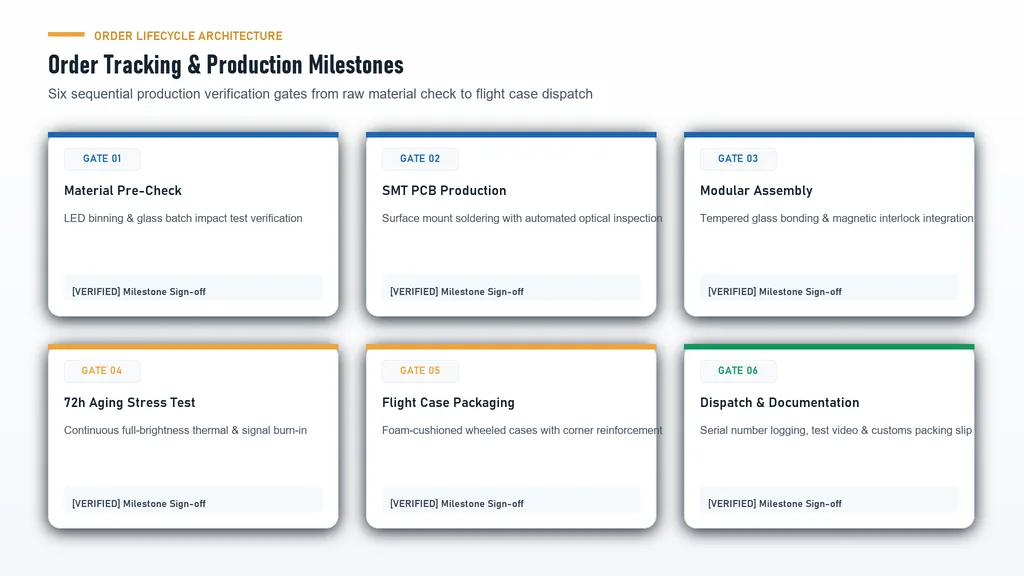
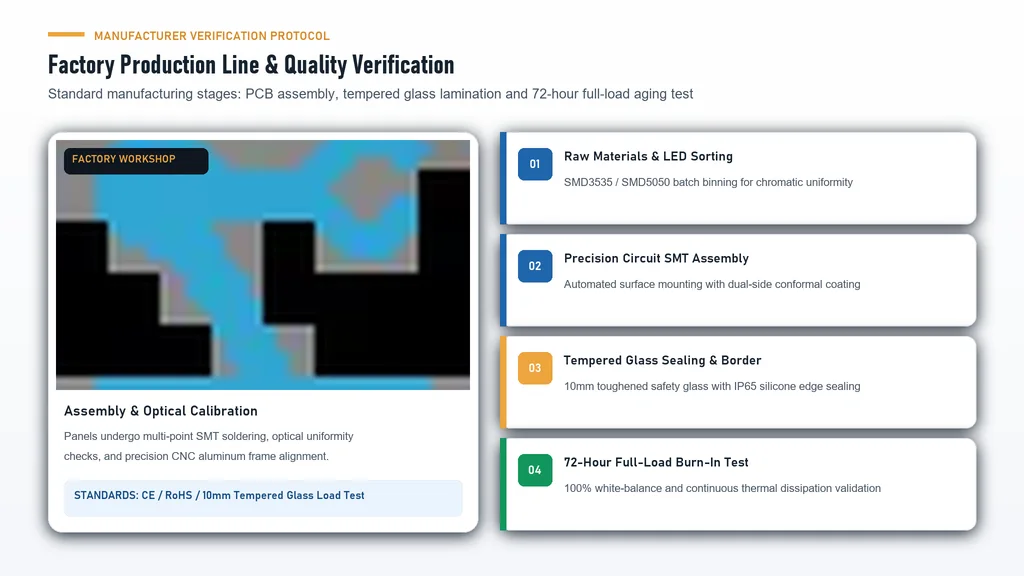
Fact: DanceFloorLED runs full-chain quality control across incoming material, sub-assembly, finished-product aging and pre-shipment sampling, with a dedicated inspection area, and tracks every order through six production stages with video records.
That quality and production detail is documented on the manufacturing services page, which is the primary evidence a distributor should ask every candidate supplier to produce in equivalent form.
What a direct-from-factory quotation should include
A quotation is the skeleton of the contract. The fastest way to compare suppliers is to compare what each number covers, so a factory-direct quote should itemise the parts a working floor needs and state what is optional.
The core is the panel: a 10mm tempered glass surface over an ABS housing, a magnetic or wired connection, and the LED engine inside. Around it you need a controller to drive the effects, a power supply matched to the configuration, the edge or border treatment that finishes the perimeter, and at least one remote. A panel without a controller and a power supply is a component, not a floor.
Outside the core, what must be written down rather than assumed is where distributors lose money. Spare panels, spare controllers, the number of power supplies, the packaging type, batteries for battery-powered configurations and the spare-panel ratio are items buyers assume are included. They usually are not, at least not at the quantity a fleet needs.
Item | Normally part of a direct order | Confirm in writing |
|---|---|---|
LED panels (glass, housing, connector) | Yes | Panel size and quantity |
Controller | Yes, one per configuration | Spare controllers for a fleet |
Power supply | Yes, matched to configuration | Count per floor and for spares |
Edge or border treatment | Depending on configuration | Wired or wireless border type |
Handheld remote | Yes, at least one | Extra remotes for operators |
Packaging | Yes | Flight case or carton, and case count |
Spare panels | Not unless agreed | Ratio, and LED-batch matching |
Batteries (battery configurations) | Optional configuration | Capacity, runtime and quantity |
Freight, duty and insurance | No | Incoterms and who arranges the movement |
The configurable specifications behind those items sit on the LED dance floor range page. Ask for the quotation to reference a model and a panel count, not a unit price in isolation, because a price per panel without the controller, power and packaging defined is not comparable.
Everything in the right-hand column, including minimum order quantity, production lead time, warranty terms and freight cost, belongs in the written quotation or contract. None of it should come from a chat message.
Samples, first articles and batch consistency
A sample tells you about a sample. The step that protects a distributor is first-article approval, where a unit drawn from the same production run as your order is inspected and signed off as the reference standard before the run continues.
Ask what the sample represents. A trade-show sample and a sample pulled from your own batch can differ in glass clarity, colour binning and connector alignment. The useful question is whether the sample comes from the line that will build your order, and whether it is retained as the golden sample.
With the golden sample agreed, batch consistency becomes a defined target. On a repeat order, colours stay consistent when the LED binning matches, the surface behaves the same when the glass source and connector tolerance are unchanged, and the control experience stays familiar when the firmware and controller version are the same. Freeze those four variables in writing.
For acceptance sampling of a finished batch, ISO 2859-1 lets you agree an acceptable quality level and sample size in advance rather than inspecting every panel [5]. Agree the sampling plan with the factory in writing.
Tracking the order: six production stages and five purchasing steps
Once the deposit is in, opacity is the distributor's main risk. A supplier that can show where your order is at any moment removes most of the uncertainty.
A transparent order moves through six stages: placed, production prepared, manufactured, tested, packed and shipped. The value is the visibility behind the labels: when each stage is documented with video or dated updates, a distributor can answer a customer's timing question without chasing the factory.
Buying runs alongside production on a five-step track: you request a quotation, the supplier returns a solution, the order and payment are confirmed, production and delivery run, and goods are received. Two steps carry the most risk. The solution step turns a vague enquiry into a defined floor, so it is the moment to fix panel size, panel count, controller, packaging and certification. The confirmation step makes those decisions binding, so the quotation must reflect everything agreed.
Fact: DanceFloorLED tracks orders through six production stages and documents them on video from testing through packing to dispatch, and its purchasing flow runs through quotation, solution, order and payment confirmation, production and delivery, and receipt of goods.
Packaging and logistics: flight case or carton
Packaging is a cost line and an operating decision at once.
A wheeled flight case is built for rental fleets: panels travel protected, the case rolls on site, and packing and unpacking is fast because the case is storage and transport in one. A carton is lighter, more compact and cheaper to move, and fits a fixed installation assembled once and left in place. Neither is better in the abstract; the question is whether the floor moves weekly or once.
Panel count and panel weight drive the freight arithmetic. A 50 cm panel weighs about 11kg and a 60 cm panel about 14kg, so a 144-panel 20x20 ft floor is a significant mass before packaging. Ask for packed dimensions and case count, not just panel count, because you ship cartons and cases, not bare panels.
Freight, duty and insurance sit on top of the goods and are not part of a goods-only price. Trade terms are defined by the ICC's Incoterms 2020 rules [6], so agree which term applies and who arranges and insures the movement before the order is confirmed. The specific freight cost, Incoterm and duty for your market are commercial terms to be quoted and confirmed in writing.
Once goods arrive, storage matters: a rental fleet needs a facility that stores cases without stacking damage, and the event solutions overview covers how floors are deployed across event types.
Import compliance: certify the model, not the catalogue
Certification is where a distributor can lose a market overnight, and where careless sellers overclaim. Certify the model, not the catalogue.
For the European Union, the CE marking framework spans the EMC Directive 2014/30/EU, covering electromagnetic compatibility, and the Low Voltage Directive 2014/35/EU, covering electrical safety within its voltage scope [1][2]. The RoHS Directive 2011/65/EU restricts hazardous substances in electrical and electronic equipment [3]. These are the frameworks a distributor checks against; the evidence behind a CE claim is the manufacturer's test documentation, and that documentation applies to the model it was issued for.
That is why a certification line should never be one blanket claim. It should name the model and the reports behind it. Certification varies by model, and the distributor's job is to match the model to the destination market. The table below reflects how DanceFloorLED's documentation is distributed across its range, and is the pattern to verify rather than assume.
Certification by model
Model | EU directives | Extra marking to request |
|---|---|---|
3D abyss LED dance floor | CE (EMC 2014/30/EU and LVD 2014/35/EU), RoHS, with LVD and EMC test documentation | Confirm current test reports for the exact configuration |
3D abyss and frosted LED dance floor | CE and RoHS | Confirm whether LVD and EMC documentation covers this variant for your market |
Pixel LED dance floor | CE and RoHS, plus CNAS laboratory testing | Confirm reports match the model and the market |
Star LED dance floor | CE and RoHS, plus CNAS laboratory testing | Confirm reports match the model and the market |
Two practical rules follow. Ask for the test report, not the badge: a logo on a web page is not evidence, while a dated report for your model is. And if you sell outside the EU, the CE set is a starting point rather than the finish; the additional approvals your destination requires should be raised with the factory before the order is placed.
Repeat orders: locking in the first order's quality
The second order has to match the first, and that is where a distributor's reputation is made or lost. The mechanism is simple: freeze the specifications that affect the customer's experience, and reference them on every later purchase order.
Freeze the LED binning and colour, so the second batch lights the same way. Freeze the glass specification and connector tolerance, so panels fit and look the same. Freeze the controller model and firmware, so the operating routine still works. Freeze the golden sample and the packaging, so a returning client opens a case identical to the last one.
Put those on a one-page re-order specification and attach it to each purchase order. It is the cheapest quality control a distributor can run, and it turns one-off purchases into a supply relationship. Where a distributor wants a private-label or specification change, that is deliberate customisation rather than drift, and the custom LED dance floor OEM/ODM guide covers the process.
Acceptance checklist before you sign off
Inspection is the last chance to catch a problem before it becomes your problem, because once goods are accepted into stock a defect becomes a customer complaint. Walk the shipment against a fixed list.
Check | What to verify | Result |
|---|---|---|
Quantity | Panel count matches the order and the packing list | Pass / Fail |
Packaging | Case or carton type, count and condition on arrival | Pass / Fail |
Panel surface | Glass clean and undamaged, edges intact | Pass / Fail |
Connection | Magnetic or wired connectors align and engage as on the golden sample | Pass / Fail |
Colour consistency | Panels light evenly with no visible colour shift across the batch | Pass / Fail |
Controller and power | Controller, power supply and remote present and functional | Pass / Fail |
Function test | Effects and control methods work as specified | Pass / Fail |
Certification pack | Test reports and documentation for the exact model are included | Pass / Fail |
Spares | Agreed spare panels and parts present and matched to the batch | Pass / Fail |
Documentation | Invoice, packing list and warranty terms match the order | Pass / Fail |
If any line fails, raise it against the pre-shipment documentation rather than accepting the shipment and resolving it later. A factory that documents its production can trace a batch back to the line, which is why the tracking discipline above is also your leverage at inspection.
FAQ
How do I verify an LED dance floor manufacturer is a real factory?
Ask for a live production-floor walkthrough, a named list of in-house processes and a documented quality system. Request references in your market. A real factory answers directly; a reseller answers in catalogue language.
What should a direct-from-factory LED dance floor quotation include?
It should itemise the panels, controller, power supply, border treatment, remote and packaging, and state what is optional: spare panels, spare controllers, batteries and freight. Anything not on the quotation is not included, so ask for it in writing.
Is a sample panel enough to judge a full order?
A sample shows what one panel can do, not what your batch will do. Ask whether it comes from the line that will produce your order and whether it is kept as the golden sample, then judge the batch against it through first-article approval and a sampling plan.
How do I keep batch quality consistent on repeat orders?
Freeze the variables your customers notice: LED binning, glass specification, connector tolerance, controller model and firmware, packaging and the golden sample. Put them on a one-page re-order specification and attach it to every purchase order.
What is the difference between a flight case and a carton for LED dance floors?
A wheeled flight case is built for rental fleets, protecting panels and speeding up on-site handling. A carton is lighter and cheaper to move, and suits a fixed installation. Choose by whether the floor travels regularly or stays put.
Which certifications should an LED dance floor carry for the EU?
Check the CE marking against the EMC Directive 2014/30/EU and the Low Voltage Directive 2014/35/EU, and check RoHS wording against Directive 2011/65/EU [1][2][3]. Certification is model-specific, so ask for the test reports for the exact model rather than a catalogue-wide claim.
How is an LED dance floor order tracked during production?
A transparent supplier documents six stages: order placed, production prepared, manufacturing, testing, packing and shipping, with video or dated updates through testing, packing and dispatch. Ask any candidate to commit to that visibility before you pay a deposit.
What should I check when the shipment arrives?
Run a fixed acceptance list: quantity, packaging, panel surfaces, connector alignment, colour consistency, controller and power, a function test, the certification pack, the agreed spares and the matching documentation. Record each line and raise any failure before accepting.
Conclusion
Buying an LED dance floor direct from the manufacturer rewards a distributor who treats it as verification rather than a hunt for the lowest number. Confirm the seller owns the line. Fix what the quotation covers and excludes. Approve a first article and freeze the variables that keep repeat orders identical. Require production tracking you can see, choose packaging around how the floor is used, and match certification to the model and the market. Accept the shipment against a written checklist.
Get those steps right and the factory-direct relationship becomes the cheapest quality control you have, because the second order arrives as good as the first. DanceFloorLED builds LED dance floors in its own plant across the abyss, frosted, pixel and star ranges, runs full-chain quality control and documents every order through six tracked stages.
Send your target model, panel count and destination market to contact the factory and you will have a quotation, including the items that need written confirmation, within 2 hours.
Sources
1. European Commission. "Electromagnetic Compatibility (EMC) Directive 2014/30/EU." EUR-Lex. https://eur-lex.europa.eu/eli/dir/2014/30/oj. EMC framework behind CE marking.
2. European Commission. "Low Voltage Directive (LVD) 2014/35/EU." EUR-Lex. https://eur-lex.europa.eu/eli/dir/2014/35/oj. Electrical-safety framework behind CE marking.
3. European Commission. "Restriction of Hazardous Substances (RoHS) Directive 2011/65/EU." EUR-Lex. https://eur-lex.europa.eu/eli/dir/2011/65/oj. RoHS scope in electrical and electronic equipment.
4. International Electrotechnical Commission. "IEC 60529: Degrees of protection provided by enclosures (IP Code)." https://webstore.iec.ch/publication/2452. Definition of IP protection ratings.
5. International Organization for Standardization. "ISO 2859-1: Sampling procedures for inspection by attributes." https://www.iso.org/standard/1141.html. Acceptance-sampling framework for a finished batch.
6. International Chamber of Commerce. "Incoterms 2020 rules." https://iccwbo.org/business-solutions/incoterms-rules/incoterms-2020/. Trade terms defining delivery, cost and risk.
7. DanceFloorLED. "Manufacturing services" page, quality control and order tracking. https://dancefloorled.com/services. Manufacturer source for six-stage order tracking and full-chain QC.
8. DanceFloorLED. "About DanceFloorLED" page, company experience and production capability. https://dancefloorled.com/about-us. Manufacturer source for factory-direct positioning and delivery volume.
led dance floor direct from the manufacturer